As soon as the question comes up, the answer is already there! A difficulty that settles in, noticeable regression, trouble sleeping… children show their inner turmoil in a whole range of ways. Do you feel like you’re losing your footing? Like you’ve exhausted every resource in vain trying to help your child? Time to head to the psychologist’s office! Don’t wait for it to “pass on its own.” Reasons to seek help, how to choose a practitioner, and the right age: a short guide for parents.
Reasons to seek help
There are many! Just like adults, children go through phases that can sometimes be hard to overcome, and which may go unnoticed by parents. Yet a persistent disorder or unease should be taken seriously. While periods of defiance, tantrums, night-time fears, or phases of regression are part of a child’s normal development, symptoms that last beyond 2 weeks call for care from a child psychologist. This can include:
- Sleep disorders (nightmares, frequent waking, needing a parent present to fall asleep)
- Difficulties linked to the arrival of a new baby brother or sister
- Repeated, disproportionate anger
- Refusal to eat or eating disorders
- Regression that drags on (bedwetting after being previously toilet-trained…)
- Unjustified fears
- A block following a major disruption (moving house, divorce, bereavement…)
- Lack of self-confidence, low self-esteem
- Sadness leading to isolation and withdrawal
- A sudden change in attitude (fear of getting dirty, refusal to accept authority, school phobia…)
- Learning difficulties at school
- A tendency to lie, steal, or engage in other behaviour they know is forbidden,
And many other attitudes.
At what age should you consult a psychologist?
From birth, a psychologist can help address a child’s difficulties. As well as helping families understand their child, the psychologist also helps resolve situations that are stuck for young patients.
Infants (from birth to age 3): the psychologist works on developmental delays (walking, language…), insomnia, nightmares, and psychosomatic illnesses.
Young children (ages 3 to 6): during this period, a child psychologist is called upon to support difficult separations, particularly leaving parents to go to school. They’re also a valuable help in understanding a lack of concentration or constant restlessness. It’s when starting CP (the French equivalent of Year 1/first grade) that DYS disorders can indeed be diagnosed (dyslexia, dysorthographia, dyscalculia, ADHD, dysexecutive syndrome…). Suspected autism spectrum concerns also find answers here: a child who avoids eye contact and remains indifferent to stimuli is a warning sign.
Children aged 7 to 10: during this period, overly frequent nightmares, loss of toilet training, or unjustified fears are all good reasons to see a child psychologist. From the point of view of cognitive and behavioural disorders, poor vocabulary and poorly constructed sentences call for a visit to a speech therapist as well as a psychologist. This is an age range during which constant clumsiness, poor motor coordination, and learning disorders can also be clearly diagnosed.
Teenagers: this will mainly involve a sudden change in attitude such as isolation, a sudden and excessive interest in something, or an eating disorder (bulimia, anorexia, loss of appetite…). It may also involve running away, stealing, self-harm, substance abuse, or a drop in self-esteem.
Psychologist, child psychiatrist, psychoanalyst: which one should you choose?
The child psychiatrist can prescribe medication and additional assessments (speech-language, psychomotor, neurological…). They can be consulted as a first step, without going through a GP first. Covered by French national health insurance, the child psychiatrist treats the majority of childhood difficulties.
The psychologist treats difficulties through words. Medication doesn’t really come into play here. The child psychologist treats children’s and teenagers’ disorders and problems through conversation, exchange, and speech. Psychologists set their own fees, which are not covered by French national health insurance. They must hold a postgraduate degree (D.E.S.S.) in psychology to practise. To get a psychologist consultation covered by French national health insurance, it’s best to contact a Medical-Psychological-Educational Centre (CMPP) or a Medical-Psychological Action Centre (CAMSP), which is dedicated to children aged 0 to 4.
The psychoanalyst works with the child’s drawings, games, dreams, and speech. Unlike the psychologist, who asks questions, the psychoanalyst listens to what the child spontaneously wants to tell them. Psychoanalysis, when it comes to children or, more precisely, teenagers, is closer to a long-term therapy, and can be recommended alongside psychological care.
“Attitudes have changed. Today, [parents] don’t hesitate to take this step, and talk about it without embarrassment, as if it were a visit to the eye doctor!”
Dr Patrice Huerre
In recent years, seeing a child psychologist has become so widespread that waiting times sometimes stretch to between 3 and 6 months. To act without delay, ORA offers parents its online psychologist service. The psychologists selected by the platform see patients at their practice, but also via e-consultation, to care for children everywhere in France and around the world. With simplified logistics and regular, high-quality follow-up without constraints, consulting a psychologist online is the solution to medical deserts, overly busy schedules and families living far from a practice!
How does a child’s care with a psychologist work?
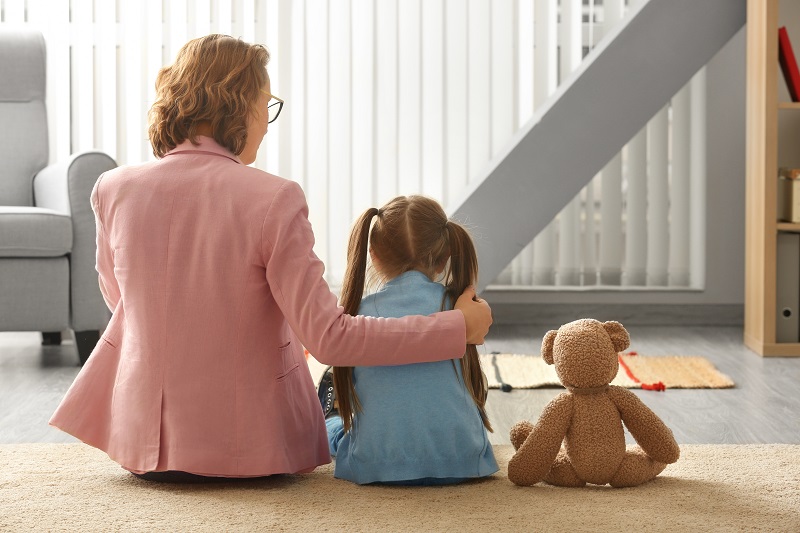
For a session to succeed, the whole family needs to be involved! With that in mind, the parents are the first to be seen by the psychologist. This is the moment to explain the difficulties they’re facing with their child’s behaviour. This step is essential, as it allows the psychologist to trace the child’s history and understand its course and any major disruptions. Taking your child to see a psychologist means being ready to reveal part of your private life, though without any judgment being made. For their part, parents will need to prepare the child for the session they’re about to take part in. This means reassuring them about the person they’re going to meet and the playful, interactive activities they’ll do together. The more confident and at ease the child feels, the easier the process will be.
The child will then be seen alone during consultations. During sessions, they’ll be invited to express themselves using felt-tip pens, pencils, modelling clay, and toys made available to them. The psychologist welcomes any form of communication the child chooses to express, through whatever means.
At the end of the session, the psychologist must give feedback to the parents and the child, and guide them towards the best possible care.
The length of psychological follow-up naturally depends on the issue being addressed and the child’s cooperation. As a general rule, the younger the child, the faster and more effective the treatment.
“In half of cases, the child doesn’t actually have a problem. It’s mainly about reassuring the parents and helping them understand certain patterns. It’s not therapeutic follow-up, but a way of opening up communication with the help of a neutral person who asks the right questions.”
Florence Millot, psychologist for children and teenagers, PARIS
While psychological help is very often effective and necessary, it’s worth remembering that in some cases, simply talking with your child, listening without judgment, and putting words to a feeling can resolve difficult situations. For everything else, the psychologist offers a helping hand towards peace of mind for children and their parents alike.