“Your eyelids are heavy, very heavy… you’re falling asleep!” That’s still the image some people have of hypnosis. Yet hypnosis is the opposite of losing control, and of the TV shows that still linger in people’s minds. It’s a practice with a therapeutic aim. It’s so effective that many health professionals now recommend it for treating disorders in children and teenagers too. Is hypnosis safe for children? In which cases is it recommended? Here are the answers, in 5 essential questions about hypnosis for children.
What is hypnosis for children?
Far from being a state of sleep, hypnosis requires a state of consciousness in which all the senses are alert. The patient remains in control of themselves, in order to access their unconscious mind. During the session, the child learns to detach from whatever is troubling them, to focus instead on what brings them wellbeing and relief. It’s an altered state of consciousness that the child will master over three sessions, so they can draw on it themselves whenever they’re alone facing whatever affects them. This is what’s called self-hypnosis. For a child who lacks self-confidence, the practitioner might, for example, suggest imagining themselves as a genie in a world where everyone needs their talents. This brief, solution-focused therapy is known as Ericksonian hypnosis. Sessions are playful, full of stories, games and imagination – ideal conditions for keeping young patients’ attention.
After these few sessions, the therapist can give the child a few tools so they can induce this hypnotic state themselves and draw on their own resources whenever needed.
“Hypnosis for children makes it possible to work on difficult issues within a context of creativity and play. Children also learn to use self-hypnosis to return to their imaginary world whenever they need to.”
Marion Cognard Magdela, Psychologist and Psychotherapist – Paris 5
Is hypnosis recommended for children?
Is hypnotising a child dangerous? Absolutely not. Quite the opposite! While adults tend to resist, despite themselves, letting their subconscious speak and detaching from reality during sessions, children react completely differently. They have a boundless imagination that’s easy to access, because they’re highly receptive. Better still, they have no preconceptions about hypnosis and find it very easy to access their own inner resources. There’s no risk at all, since on the one hand the child stays conscious throughout and is guided towards solutions for their own wellbeing that they themselves generate. And on the other hand, the playful, enjoyable format of the sessions means children take part with pleasure and motivation. So in the young patients’ minds, these consultations aren’t associated with medical treatment.
“Children are especially receptive to hypnosis. Two to three sessions are often enough to put a stop to a behavioural or emotional issue.”
Lise Bartoli, clinical psychologist and hypnotherapist – Paris
From what age can a child be hypnotised?
0 to 3 years old: infants can safely benefit from a hypnopractitioner’s expertise. At this age, hypnosis sessions are generally used to carry out a medical procedure under the best possible conditions for the very young child. The therapist will use stimuli and various other distraction methods: touch, comfort, cuddling, rocking, soothing whispers…
- 3 to 6 years old: young children have a limited attention span. To work around this, the hypnosis session is broken into several stages. By alternating, for example, hypnotic stories, games, and handling of materials with breathing exercises, physical exercises and mime, the hypnotherapist naturally guides the child towards the solution, adapting to their young patient as the session unfolds. What matters most throughout all these stages is that the child can recognise their own feelings.
- From age 6: the child can draw on the full potential of hypnosis, since they’ve reached the age of reason. Able to build their own thinking and imagine things independently, they take full part in the session. This makes the results and effectiveness of hypnosis all the greater.
- In adolescence: the potential of hypnosis remains significant. However, new factors come into play, particularly the teenager’s own preconceptions about hypnosis and their willingness (or not) to commit to this form of therapy.
For which conditions is hypnosis recommended for children?
To tackle certain everyday difficulties, to ease painful treatments or recurring ailments, or as a complement to medical follow-up or medication, hypnosis for children delivers all its benefits. It’s generally recommended in the following cases:
- Enuresis, or bedwetting.
- Encopresis, or faecal incontinence.
- Low self-esteem and lack of self-confidence (whether caused by a disorder such as dyslexia, dyspraxia, dyscalculia, dysorthographia… or not).
- Various fears and phobias.
- Sleep disorders.
- Difficulty managing emotions (sadness, anger, anxiety, shyness…).
- The effects of ADHD (stress, lack of concentration, forgetfulness, restlessness…).
- Gifted profiles (inattention, hypersensitivity…).
- Various eating disorders (anorexia, bulimia…).
How does a hypnosis session with a child work?
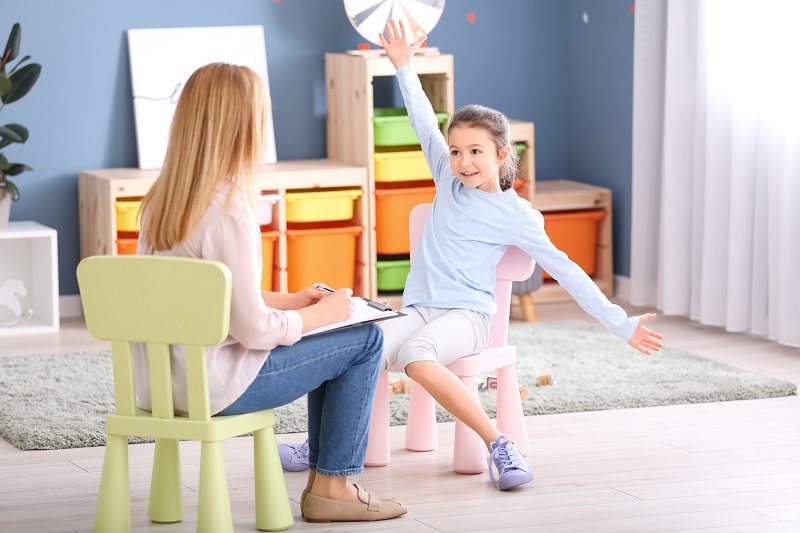
To be effective, a hypnosis session does need to take place without the parents present. Worried about leaving your child alone with a stranger? Rest assured, parents: you’ll have all the time you need to get to know the hypnotherapist during the first session. Indeed, this first appointment takes place with the parents, and siblings too if needed. During this initial meeting, the family and the child define the goal of the therapy to come. Parents can ask the practitioner all their questions (and share their concerns). Likewise, the professional will take an interest in how the family works. At the end of this discussion, a few activities will be suggested to the child to kick off the work ahead.
The following consultations take place with the child alone. Listening, sharing and understanding are the watchwords of these appointments. Parents are welcome to stay in the waiting room or leave the practice, as they prefer. The parents’ absence is essential for two reasons. Firstly, because the child won’t react the same way in the presence of their parents (or a parent). And secondly, because it would deprive them of an important realisation: that they’re capable of managing their own therapy and finding solutions without anyone’s help. At the end of the session, the hypnotherapist will give the parent a summary.
The hypnosis session lasts between 30 minutes and 1 hour, depending on the child’s age.
The benefits of hypnosis for children are clear and well recognised. More than just a medical technique, hypnosis can become a genuine way of life. Beyond the immediate results it brings, this particular state of consciousness, once well learned in childhood, can become a real source of support for adult life to come!
Dvora Léa P. offers remote hypnosis sessions on the ORA platform.