With the Covid-19 pandemic, lockdown turns parents of young children into teachers and puts middle and high schoolers in charge of their own studies. For some families, these moments are precious, a return to essential values. Spending time together, sharing activities, talking… Nevertheless, these health measures get in the way of caring for children with disabilities or special needs. Speech therapy follow-up, school support tailored to a DYS disorder, or psychological care for these children are all a priority. How can you make the most of lockdown without setting back a child’s schooling, speech therapy, or psychological wellbeing?
School support: essential during lockdown
A learning difficulty in one subject can quickly discourage a student. Day to day, they can still rely on their teacher’s presence, ask questions, and have their homework adjusted to their weaknesses. What’s left of this differentiated teaching during lockdown? Clearly, a lot of school-related distress.
Left alone with what they don’t understand, a middle or high schooler struggling in maths, French, history-geography, English, or any other subject, is at a loss. The risks are losing interest, falling even further behind, or even rejecting the subject altogether. Why not turn this unprecedented situation into a springboard instead? Since they’re stuck at home anyway, why not catch up in the subjects they dread most! The ORA platform’s online school support solutions are a real opportunity for these struggling students. With qualified teachers, homeschooling becomes an opportunity.
Homeschooling for children with DYS disorders and ADHD
The CNED (France’s national distance-learning centre) and other online learning systems are good initiatives to allow schoolchildren to keep learning at home, but what about children with DYS disorders or ADHD? Many students with disabilities benefit from an individualised care plan (PAI) or personalised schooling plan (PPS) at their school. However, this lockdown has shattered the accommodations designed to improve these children’s learning. Dyslexic children in particular need instructions read aloud, and goals set in advance and based on topics they enjoy. How can these methods be applied when facing a standard worksheet, alone behind a screen or in front of a blank page?
The same goes for dysphasic and dyspraxic children. These children need to be encouraged to express themselves through gestures and images, far removed from the written output expected from online work. For example, they need simplified instructions adapted to their disorders, with distinct colours, larger fonts, and plenty of pictograms. For children with ADHD, the teacher usually sets up cues to help control the student’s impulsivity (a gesture, a sign…). They know how to meet the child’s constant need to move and adapt school-work instructions by breaking down goals or giving instructions one at a time. These safeguards are obviously undermined by isolation and homeschooling. These children are seriously at risk of discouragement and a drop in self-esteem.
It is for these dyslexic children, as well as those with dysphasia, dyspraxia, or ADHD, that ORA has dedicated its online learning platform. The teachers who run video lessons specialise in DYS disorders, ADHD, and autism spectrum disorders. Their approach to school support takes full account of these children’s particular difficulties, offering activities that encourage them, reassure them, and help them regain confidence in their potential.
Lockdown and speech-therapy treatment
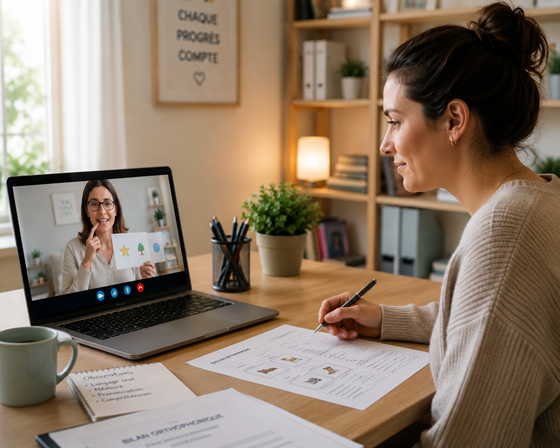
During this exceptional period, the ORA platform opened its doors free of charge to all professionals wishing to continue seeing their patients during lockdown. Why? Because a delay in spoken or written language development, a disability that hinders communication and understanding, or post-trauma rehabilitation of speech, must not be neglected. In speech therapy, consistency is a genuine key to success. To be effective, speech-therapy sessions must follow certain rules, particularly a regular, sustained pace.
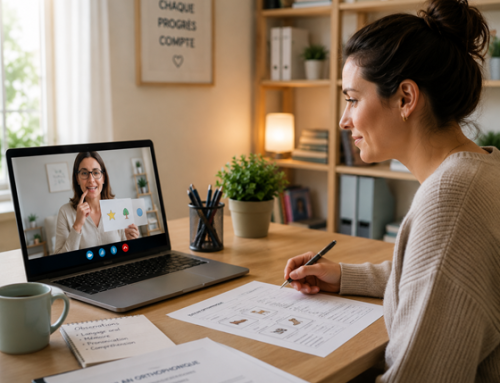
That’s the purpose behind ORA’s gateway to online speech-therapy sessions. In normal times, the logistics of family life, medical deserts, and long waiting lists already make online speech-therapy follow-up an appealing choice. The lockdown imposed by the government has only sped up this shift further. From now on, speech-therapy sessions can only be carried out remotely, to limit the spread of the coronavirus. Available everywhere in France, at flexible times, and with qualified practitioners, e-health is becoming mainstream, and everyone benefits!
Lockdown and psychological follow-up
This is an unprecedented period. Staying shut in at home for an unknown length of time is hard for most adults to accept. What about children? The youngest ones can’t yet put it into words and absorb the stress carried by their parents. Older children may not find the words either, and internalise it physically, at the risk of it going unnoticed. Professional advice is simple: it’s important to explain the reason for the lockdown to them, answer their questions, and keep up a pleasant, structuring daily routine (as far as possible). And why not encourage them to draw or play, to work through worries through art and play? However, children and teenagers who were already receiving care before the lockdown must not be allowed to lose the progress they had made. Disrupting these patients’ psychological follow-up can have serious consequences for their psychological balance and health. Since lockdown no longer allows access to psychologists’ offices, the ORA platform has expanded its online psychology session offering, by opening free access to professionals who wish to keep seeing their patients during this period.
“You need to stay alert to the impact of lockdown on your child. If they’re very anxious, if they’ve stopped sleeping, or if they withdraw in an unusual way, it’s important to help them by seeking outside support. The child may want to talk to a trusted person outside the family. There are also options for remote consultations with health and psychology professionals.”
Peggy Beyer, clinical psychologist
While a few nightmares, trouble falling asleep, or excess energy are normal consequences of lockdown for children, other symptoms deserve more attention. Developmental delays, regression, anorexia, bulimia, or withdrawal, to name just a few, require psychological care. Here too, online sessions with a child psychologist are entirely appropriate. ORA brings together qualified psychologists accessible from anywhere in the world, so that no one is left isolated with their struggles.
What about French expatriates during lockdown? Being abroad can obviously heighten the feeling of distance, especially from family members locked down back home. Border closures may be seen by some expatriates as a risk of being unable to return, a sense of exclusion of unknown duration. These are also the people that ORA’s online psychologists support all over the world through its e-health platform.
Staying home is a genuine priority. Learning that lockdown doesn’t mean giving up on psychological work, on improving language, or on schooling for struggling children, is an opportunity worth seizing.
Finally, for all parents concerned about their children’s wellbeing, as well as their own mental health, the government has published a short guide available here.