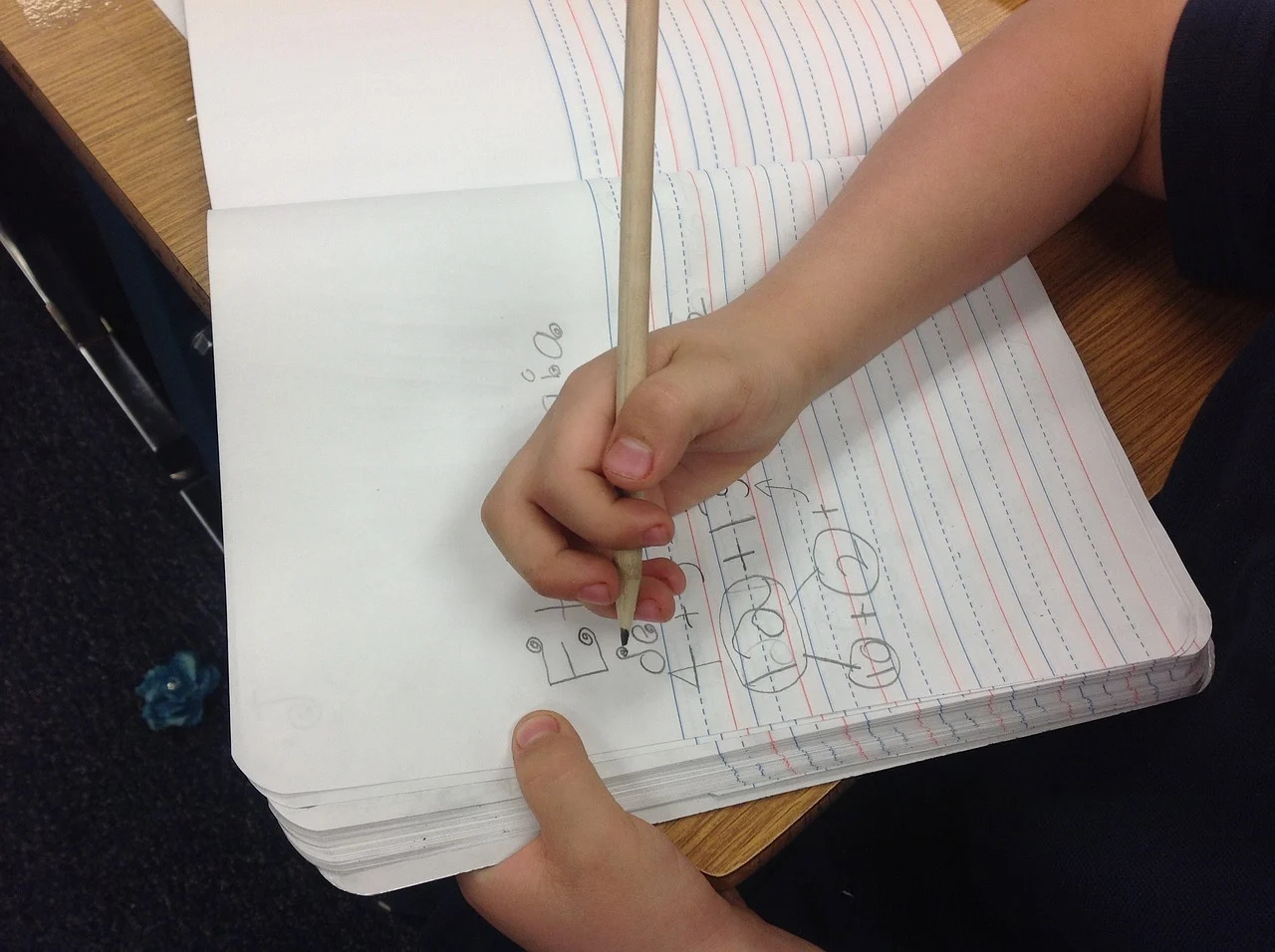
Traditionally, a graphotherapist is called on from Grande Section onward, in cases of difficulty with handwriting, whether in the pen strokes themselves (direction, proportion, how letters are joined…) or in the movement involved (poor pencil grip…), resulting in handwriting that is hard to read or simply slow. Before any remediation, the professional carries out a graphomotor assessment, made up of the case history and a series of tests…
Step one: the case history
In graphotherapy, the case history refers to discussions with the child (and their parents), in order to gather as much information as possible about their personal and school background. Through this conversation, the professional needs to understand the reason for the consultation. With this in mind, it is strongly recommended to bring along any assessments already carried out, such as one from a speech therapist or psychologist. Traditionally, this stage, essential to the diagnosis, lasts around 30 minutes for children under 18.
Step two: graphomotor tests
The graphomotor assessment continues with a series of tests, in order to draw up a personalised remediation plan directly tied to the child’s specific difficulties. These generally last around 1 hour 30 minutes: tests of handwriting style, speed, hand tone and fine motor skills, spatial and temporal awareness, balance, posture and pencil grip, vision, reading, drawing, precision and pressure, as well as number writing and geometry.
All these exercises aim to assess the child’s knowledge of letters and numbers, their mastery of shapes, the effectiveness of their vision, their left-right coordination, the simultaneous activation of both hemispheres of the brain, their relationship with handwriting, but also their posture, their pen grip, their overall attitude, and their handwriting level compared with the average for other children their age.
Step three: assessing graphomotor age
Finally, the graphomotor assessment ends with an analysis of the results of these various tests, aiming to determine the child’s graphomotor age: this is calculated using Dr Julian de Ajuriaguerra’s dysgraphia scale, which uses 30 items to place children aged 6 to 12 on a handwriting-level scale.
A report is generally sent to the family within 15 days, delivered electronically or in person at an appointment.
This analysis document is used to draw up a personalised remediation plan, including, where relevant, a referral to another specialist (orthoptist, speech therapist, occupational therapist…). Generally set at between 5 and 20 sessions, these are adapted according to the child’s age and progress.
Why should writing difficulties be diagnosed?
A writing problem is always the expression of an underlying symptom: as such, a diagnosis, made as early as possible, is strongly recommended. It can reveal vision problems (convergence, hand-eye coordination…), Attention Deficit Disorder with or without hyperactivity (ADHD), or a DYS disorder (dyslexia, dyspraxia, dyscalculia, dysorthographia…). Note that gifted children (HPI) often have significant handwriting difficulties.
Here, the graphomotor assessment helps shed light on the origins of the writing difficulties and provide the most appropriate response.