Dyslexia: how to learn a foreign language without losing the plot?
It’s settled! Your dyslexic child has managed to master the pronunciation of tricky French sounds. When someone mentions learning a second language, you immediately think of all the sounds that are pronounced differently from one language to another. You’d rather steer clear, for fear of shaking up knowledge that was so hard-won. That’s a shame, because being dyslexic and learning a foreign language are entirely compatible. What difficulties should you expect? Which language should you favour?
The enemy can become an ally, if you know how to approach it
Even with the greatest motivation, dyslexia lurks in the shadows, ready to turn every stage of learning into an obstacle. How do you knock it out? Anticipation! Becoming aware of the major difficulties involved in acquiring a new language is a first step towards victory. To speak a second language, a dyslexic child will face four major challenges:
- Processing new information more quickly
- Managing two language systems at once
- Learning a new pronunciation system
- Telling several distinct messages apart
Dyslexia is a specific reading disorder. It is also a persistent disorder in the acquisition of written language, characterised by major difficulties in acquiring and automating the mechanisms needed to master written language (reading, writing, spelling, etc.).
WHO (World Health Organization)
Mastering the 36 phonemes of the French language is already a hard road for dyslexic children. Starting from scratch to learn a new language is indeed a considerable challenge. A dyslexic child’s brain isn’t naturally inclined towards language-learning activity, and the further the phonetic system of the foreign language is from that of their mother tongue, the harder the struggle will be. Beyond phonology, memorising words and sounds is difficult for people with dyslexia. This relates to what is known as auditory and visual memory. Associating an image and a sound with an object is a skill that dyslexic children often lack. So asking them to associate two different words for the same object, or two pronunciations for the same phoneme, becomes a real challenge. These obstacles aren’t limited to speaking or reading either, they also affect writing.
Where can you find solid support to take on the foreign-language challenge?
The first form of help comes from choosing the right language. Languages fall into two broad categories. Some are considered transparent or regular. Their strength: each sound has only one way of being written. A dream that French children never experience. There are no silent letters. Yet this paradise of simplicity exists, in languages such as Finnish, Italian, Greek or Spanish. With 33 graphemes for 25 phonemes (almost one spelling per sound), Italian is the easiest language to read, the most logical to write, and has only a handful of exceptions. It’s edged out of first place by Esperanto (the international language created in 1887, which has no ambiguity at all).
Learning a language that is more transparent than one’s mother tongue has positive effects on understanding the phonological system.
Da Fontoura et al. studies, 1995; Muntaz et al., 2001
By contrast, English, French and Dutch are considered opaque or irregular languages. They have several ways of writing one and the same sound. Just take the French sound “è”, which can be written “è”, “ai”, “ei” or “ê” – a real nightmare for children with dyslexia. Their rules are complex. English, for example, has 1,120 graphemes for 40 phonemes, meaning an average of 3 different ways of writing the same sound! French is just as opaque, with 190 graphemes for only 35 phonemes. Logically, learning an opaque language will be more complicated and slower than learning a transparent one.
Ranked by difficulty:
- English
- French
- German
- Spanish
- Italian
Tips for getting a handle on the new language
Whatever foreign language is chosen, a dyslexic child needs specific accommodations and adapted methods. Here’s an overview of the choices and attitudes to adopt with a dyslexic learner.
- Wherever possible, choose a transparent language.
- Favour spoken learning materials (software, recordings, etc.) and generally prioritise the oral side of language.
- Be very tolerant of mistakes. In other words, don’t dwell on them as long as the message gets across.
- Favour full immersion in the language.
- Use highly visual materials, multiplying the ways in to understanding.

- Seek help to adapt learning at school, support revision and adjust exam conditions. Building an MDPH file (the French disability agency application) helps secure these rights.
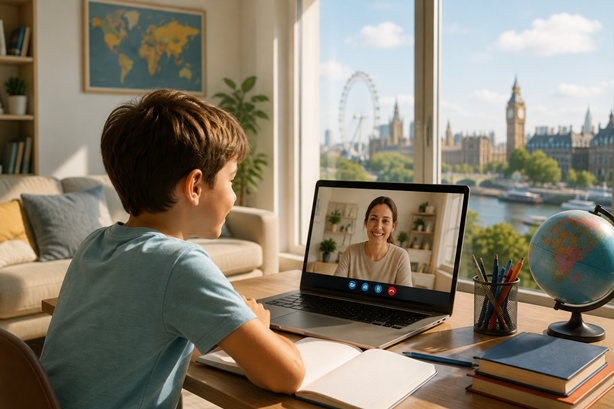
Dyslexia is a learning disorder managed by speech therapists. To make booking appointments easier, and remove the hassle of waiting rooms and costly travel, the ORA platform has built a network of qualified speech therapists who practise both in person and remotely. Online speech therapy consultations allow families to follow their child’s speech therapy rigorously, from home, anywhere in the world. This kind of support can go hand in hand with learning a foreign language, since there’s no longer any doubt: a dyslexic child can rise to this challenge!