At the first appointment with a health or support professional, they will often give you a report that they describe as the case history report (anamnesis).
But what exactly does this term mean? And what is it for?
What is a case history?
The word case history (or anamnesis) refers to the gathering of information that allows the professional to better understand the history and situation of the person they are supporting.
So it is not simply a matter of filling in a questionnaire or answering a series of questions. The case history makes it possible to place the issue (the reason for the appointment) in its context.
Depending on the professional consulted and the reason for the appointment, the information sought may concern:
- the reason for the consultation;
- the difficulties or symptoms experienced;
- when they appeared and how they have developed;
- relevant medical or psychological history;
- school or professional background;
- tests or assessments already carried out;
- previous support or treatment;
- lifestyle habits or daily life;
- the family or environmental context, where relevant.
Obviously, not every question is asked of everyone. The content of the case history is adapted to the situation and to the practitioner’s profession.
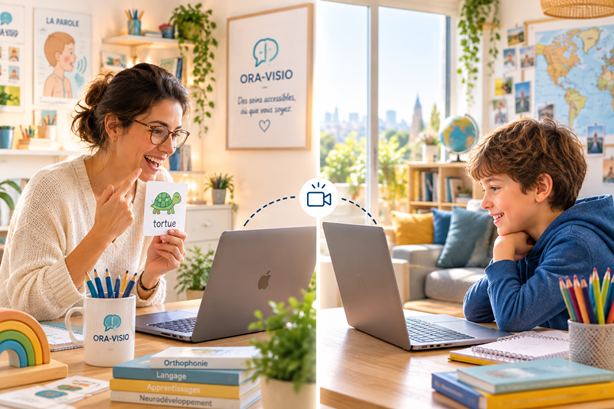
However, whether the appointment takes place in the practitioner’s office or by teleconsultation, as on the Ora-visio platform, the case history is always a prerequisite.
Why does your practitioner need all this information?
A difficulty cannot always be understood by focusing only on what is happening at a given moment.
Take the example of a child who is having difficulties with reading.
A speech therapist may need to know:
- when and by whom the difficulties were raised (observations during homework time, a note from the teacher)
- how their language development went,
- how things are going at school (relationships with classmates and the teacher, behaviour)
- whether there is any particular family history (since we now know that neurodevelopmental disorders have a strong hereditary and genetic component)
- whether the pregnancy went well (stress of the mother-to-be, caesarean and/or premature birth)
- or whether assessments have already been carried out (by an ENT specialist to check hearing, an ophthalmologist for vision, an orthoptist for convergence or divergence)
- whether the child eats properly, sleeps well and does any physical activity.
In the same way, in the context of psychological support, certain information about the person’s current context and history can help the psychologist to better understand the request and to adapt their support.
The case history therefore makes it possible not to treat a difficulty as an isolated element, but to place it within the person’s history and environment.
Is the case history an interrogation?
Not really.
Even though it may take the form of a questionnaire, the case history is above all a time for exchange and understanding.
The answers given may lead the practitioner to ask other questions, clarify certain points or discover an important piece of information.
The aim is not to give the “right answers to a quiz”, but to provide information that will allow the practitioner to understand the situation as well as possible.
It is therefore important to answer the questions you are asked as precisely as possible, without trying to interpret the requested information yourself.
It also allows the professional to tell you whether you are in the right place or, on the contrary, whether you should see another practitioner who will be better able to help you.
This is also why it is sometimes necessary to start with a Neuropsychological Screening and Referral Consultation (CNRO), that is, an “in-depth 2-hour interview during which we go over your child’s developmental, school and family history together, as well as the difficulties they are currently experiencing. The aim is to better understand the situation, to identify any signs suggestive of a Neurodevelopmental Disorder (NDD) or, on the contrary, to highlight reassuring elements. This consultation helps avoid unsuitable steps or non-priority assessments, which often cost families time, energy and money. At the end of the interview, you leave with a clearer picture of the situation and concrete recommendations: priorities to explore, relevant assessments, professionals or services to consult, first steps to put in place in everyday life.” Anaëlle Audebert, psychologist and neuropsychologist at Ora-visio.
What if the consultation concerns my child?
When a child is being supported, the case history is generally completed with the help of their parents or legal guardians.
The professional may in particular seek to learn more about:
- their development since birth (health problems, growth delay, …)
- or any assessments already carried out (speech therapy assessment, WISC test, neuropsychological assessment, IQ test, …)
- their school background (their relationship with school, their results,…)
- the difficulties they have experienced and are experiencing now (parents’ separation, bereavement, blended family, illnesses)
- their environment:
- their family (parents, siblings)
- their home (flat or house, garden, own bedroom)
- childcare arrangements
This information is particularly useful when the child cannot yet explain certain aspects of their history on their own. However, it is important to then give the floor to the person concerned and to the parents (or those accompanying them at the appointment) to complete and clarify the facts.
Can the case history be used to make a diagnosis?
The case history alone generally does not make it possible to make a diagnosis.
It is an information-gathering step that can contribute to the overall assessment of the situation.
Depending on the reason for the consultation, the professional may need:
- another in-depth interview with the child,
- observation sessions,
- tests,
- an assessment,
- or other information before being able to draw conclusions.
The case history is therefore rather a starting point for understanding the situation, and not a conclusion in itself. This report will very often be sent to you by email. It is part of the patient’s medical record and can only be shared with your consent.
In conclusion:
The case history is the first important step in many forms of support. It allows the practitioner to better understand who you are, what brings you to consult and the context in which the difficulty arises.
To find out more:
- another article on our blog: When you have questions about your child’s development: what is a Neuropsychological Screening and Referral Consultation (CNRO) for?
- other articles on the website of our partner Dys-positif.fr, for example (in French): Orthoptie, un outil de diagnostic de la dyslexie ?