Your child has just been diagnosed with dyslexia, dyspraxia, developmental language disorder (dysphasia) or ADHD. The speech therapist has handed over the report. You now know that they may be entitled to support — but faced with MDPH forms, incomprehensible acronyms and administrative delays, many parents give up before they even start.
This guide takes you step by step through putting together an MDPH application for a child with dys disorders or ADHD. Documents to gather, available support, timeframes to know, mistakes to avoid: everything you need to know to maximise your chances of obtaining appropriate support.
Book a speech therapy assessment for my MDPH application
Report structured for the MDPH · Available within a few days · State-certified speech therapists
Why apply to the MDPH for a child with a dys disorder?
Since the French law of 11 February 2005 on equal rights and opportunities, specific learning disorders — dyslexia, dysorthographia, developmental language disorder (dysphasia), dyscalculia, dyspraxia — have been recognised as disabilities. As such, the children affected are entitled to specific compensation and adjustments for their schooling.
The MDPH (Maison Départementale des Personnes Handicapées, the departmental disability centre) is the one-stop shop that processes these applications. It grants support based on an assessment of each child’s needs. Without an MDPH application, certain types of support — in particular the presence of an AESH, adapted teaching equipment or the AEEH — cannot be obtained.
⚠️ The MDPH is not the first step. Before submitting an MDPH application, consider setting up a PAP (Plan d’Accompagnement Personnalisé, a personalised support plan) directly with the school — it is quicker (3 to 6 weeks) and is often enough for mild to moderate disorders. The MDPH comes in when the needs are greater.
What support can a child with a dys disorder obtain through the MDPH?
Before starting to put the application together, it is useful to know what the MDPH can grant. For a child with dys disorders, the main types of support are:
The AESH (Accompagnant des Élèves en Situation de Handicap, a teaching assistant for pupils with disabilities). An adult present in class to help the child with their learning and organisation. Support can be individual, shared (between several pupils) or collective.
The AEEH (Allocation d’Éducation de l’Enfant Handicapé, an education allowance for children with disabilities). Financial support paid to parents to offset the extra costs of the child’s care and support (speech therapy and occupational therapy sessions, adapted equipment…).
Adapted teaching equipment. Computer, text-to-speech software, adapted mouse, scanner to digitise documents… This equipment can be funded or provided through the MDPH.
The PPS (Projet Personnalisé de Scolarisation, a personalised schooling plan). A more comprehensive arrangement than the PAP, which includes all school adjustments, human and material support, and adapted educational goals. It is drawn up by the schooling follow-up team (ESS), which brings together parents, teachers, the school doctor and professionals.
Extra time (tiers-temps) in official exams. Unlike the PAP, MDPH recognition makes it much easier to obtain extra time for the brevet and the baccalauréat. With a PPS in place, the process is simplified.
The documents to gather: what goes into the MDPH application
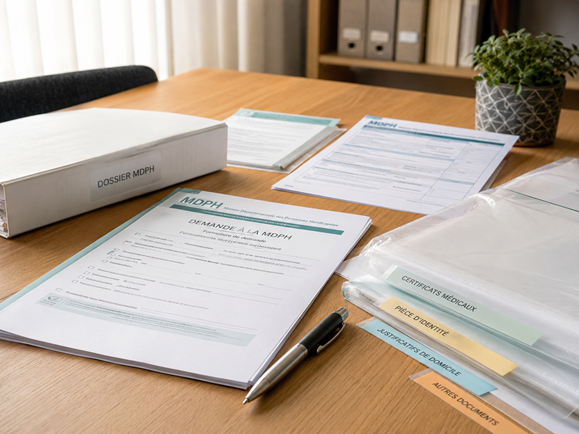
The MDPH application has an administrative part and a medical part. Here are the essential documents:
Mandatory administrative documents
□ The Cerfa application form for rights (available on the CNSA website or directly from your MDPH)
□ A copy of the family record book (livret de famille) or the child’s birth certificate
□ Recent proof of address (less than 3 months old)
□ The life plan (projet de vie): a free-form document in which the parents describe the child’s difficulties in everyday life and at school, and state the support they would like. It is an often underestimated but decisive document — the more precise and concrete it is, the stronger the application.
Medical documents — the backbone of the application
□ The MDPH medical certificate: completed by the GP or paediatrician, it certifies the diagnosis, its severity and the ongoing treatment. It is the central document of the medical file. A certificate that is too vague weakens the application — ask your doctor to be precise about the diagnosed disorders and their concrete impact on schooling.
□ The speech therapy assessment report: this is the priority document expected by the MDPH’s multidisciplinary team. It must contain the scores obtained in standardised tests, the stated diagnosis and the recommended adjustments. Without it, the assessment of the application is blocked.
□ Other assessments carried out, if relevant: neuropsychological, occupational therapy, psychomotor, ophthalmological assessment…
□ Reports from specialist medical consultations (paediatric neurologist, child psychiatrist…) if the child has been followed
School documents
□ The GEVA-Sco form (guide for assessing compensation needs in schooling): completed by the teaching team, it describes the child’s difficulties at school and the adjustments already in place.
□ The latest school reports (2 to 3 years)
□ The current PAP, if one has already been set up
Book a speech therapy assessment for my MDPH application
Report structured for the MDPH · Available within a few days · State-certified speech therapists
The submission steps and processing time
How do you submit the application?
The application can be submitted in three ways:
- Online at mdphenligne.cnsa.fr (recommended to make follow-up easier)
- By registered letter with acknowledgement of receipt to the MDPH of your department
- In person at the MDPH desk, with an acknowledgement of receipt
What timeframes should you expect?
The legal processing time for an MDPH application is 4 months. In practice, it varies between 3 and 6 months depending on the department and the complexity of the application. If there is no reply after 4 months, the MDPH is supposed to notify you of an extension.
⚠️ Always plan ahead. If you need adjustments for the next school year, submit the application at least 6 months in advance. For extra time at the brevet or the bac, existing MDPH recognition makes the process considerably simpler.
Tips to maximise the chances of your application being accepted
A well-prepared MDPH application has a much better chance of being accepted the first time. Here are the key points to watch:
Be precise in the life plan. Avoid vague wording such as “my child has difficulties at school”. Describe concrete situations: “It takes him 45 minutes to copy an exercise that his classmates do in 10 minutes”, “He has cried every evening before homework since September”, “He has been the last to hand in his work for 2 years”.
Insist on a complete medical certificate. The certificate must specify the diagnosed disorder(s), their degree of severity, the ongoing treatment (speech therapy, occupational therapy…) and the recommended adjustments. A certificate that is too brief is the leading cause of refusal or underestimation of needs.
Attach the speech therapy assessment as a priority. Without this document, the application is incomplete in the eyes of the MDPH. If you do not yet have an assessment, an online assessment lets you get one quickly, with a structured report that precisely meets the MDPH’s requirements.
Flag the urgency if schooling is at risk. If the child is at serious risk of dropping out of school, mention this explicitly in the cover letter and ask for priority processing. Some MDPHs have a French national education contact who can speed up urgent applications.
Get support. Associations such as APAJH, FFDYS or local ULIS units can help you write and put together the application. The school doctor is also a valuable ally — do not hesitate to ask for their help.
FAQ — MDPH application for a child with a dys disorder
Is the MDPH application valid for life?
No. The rights granted by the MDPH are for a fixed period — generally 1 to 3 years for children, sometimes up to 5 years for stable disorders. When they expire, the application must be renewed with updated medical documents. Plan this renewal several months ahead.
My child has a PAP: do we still need to make an MDPH application?
Not necessarily. If the adjustments in the PAP are enough to compensate for your child’s difficulties, an MDPH application is not mandatory. The MDPH is useful when the needs go beyond what the PAP can offer: the need for an AESH, financial support (AEEH), guaranteed extra time in national exams, or expensive equipment.
Can you submit an MDPH application without a speech therapy assessment?
Technically yes — the application can be submitted with the medical certificate alone. But in practice, the absence of a speech therapy assessment considerably weakens the application for dys disorders, because the MDPH’s multidisciplinary team expects this document to establish the diagnosis objectively. An application without an assessment risks refusal or an underestimation of needs.
What should you do if the MDPH refuses?
If the application is refused or the support granted is insufficient, you can file an informal appeal with the MDPH within 2 months. If this appeal fails, a formal appeal to the administrative court is possible. In all cases, strengthen the application with additional medical documents and a more detailed description of the impact of the disorders on daily life.
Conclusion: the MDPH application, an investment worth making
Putting together an MDPH application takes time and energy. But the support obtained — AESH, adapted equipment, AEEH, extra time — can make a lasting difference to your child’s schooling and significantly ease the family’s financial and emotional burden.
The first step, often the most urgent, is to obtain the speech therapy assessment. Without it, no administrative process is really possible — neither a PAP nor an MDPH application. If you cannot wait 12 to 18 months on an office waiting list, an online assessment lets you move forward immediately.
Book a speech therapy assessment for my MDPH application
Report structured for the MDPH · Available within a few days · State-certified speech therapists