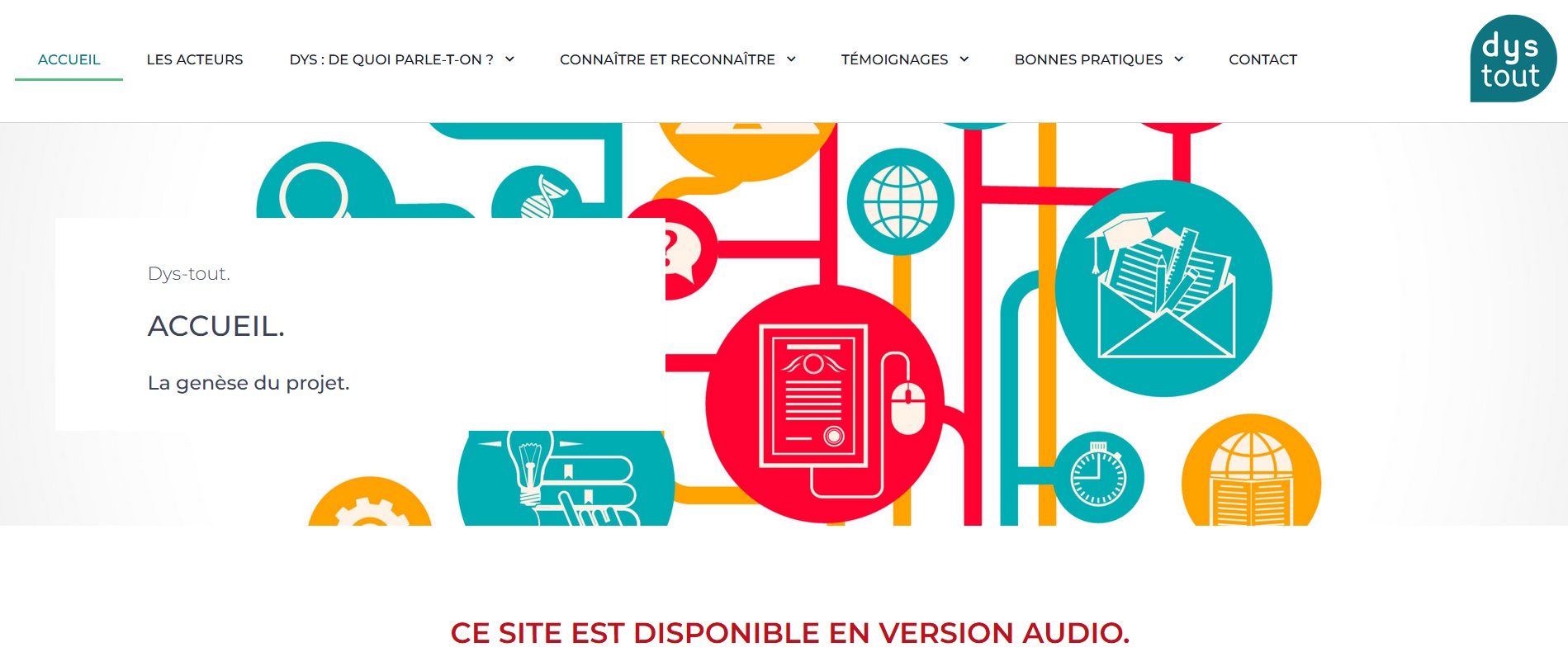
While DYS disorders must be diagnosed as early as possible, they remain lasting: taking these difficulties into account is essential at school, but also within organisations dedicated to continuing professional training. The website dys-tout.fr presents itself as a toolkit for these organisations. An overview.
DYS disorders persist into adulthood
In France, 1 person in 10 has a DYS disorder, whether dyslexia, dysorthographia, dyscalculia, dysgraphia, dyspraxia, dysphasia and/or attention deficit disorder with or without hyperactivity. These are “glitches” of a pathological nature, which need to be identified and addressed in order to design adaptations and accommodations in teaching methods…
Lasting, these DYS disorders do not disappear with age; the child simply learns to work around their difficulties. As a result, the problems encountered from school age onward reappear in adult vocational training.
The dys-tout.fr website, enriching teaching practices
“After various discussions with Apedys 22, training and career-guidance professionals agreed that it was necessary to work on this issue,” notes Laurence Lanoë, director of the Mission locale Centre-Bretagne[1]. This is a challenge for organisations, but also for young people themselves and their parents.
As a result, “an inter-organisation working group was formed: Amisep, Adaléa, CFPPA, Afpa, Émeraude ID and Greta. The idea is to allow these adults in training either to build up their skills through adapted teaching methods, or, for the youngest adults, to find support,” explains Laurence Lanoë1.
This consultation gave rise to the dys-tout.fr website, which aims to pool everyone’s work, share it, and gradually improve the responses offered. After an overview of DYS disorders, their causes and consequences, the site provides the keys to understanding them, spotting them, and “working with” them.
“Best practices” for adults with DYS
The educational website dys-tout.fr sets out a set of “best practices” for training professionals who work with trainees affected by DYS disorders. It also offers a range of possible accommodations:
- Educational: formatting documents, setting up working methods, solutions to make reading easier and to support assessment;
- IT-based: methods to make reading easier (colour-coding, writing tools…) and software (Dragon, Freemind…);
- Other accommodations & adaptations: allowing rest periods, explaining the situation to other trainees with the person’s consent, and considering spatial-temporal, personal and psychological compensations.
Of course, the dys-tout.fr website also invites professionals from adult training organisations to talk with their trainees, in order to guide them better (Mission Locale Centre Bretagne, for example) or to support them better (speech and language therapist, occupational therapist, etc.).
[1] Citation: https://www.letelegramme.fr/cotes-darmor/loudeac/formation-un-site-internet-pour-mieux-prendre-en-compte-les-troubles-dys-27-01-2022-12912660.php