Waiting room of a medical centre. One sentence flies, and it’s the start of a misunderstanding.
“- Jules has started seeing the ortho.
– Oh really, does he have eyesight problems?
– No, no, the speech therapist!”
And there you have it: a simple conversation can quickly turn into a medical guessing game. Speech therapist (orthophonist), orthoptist, orthodontist, orthopedagogue… It’s as if every health profession agreed to share the same prefix (ortho!). Indeed, behind the prefix ortho-, several very different health professions are hiding:
🌀 The “ortho” jungle
To stop mixing them up, here’s a little survival guide:
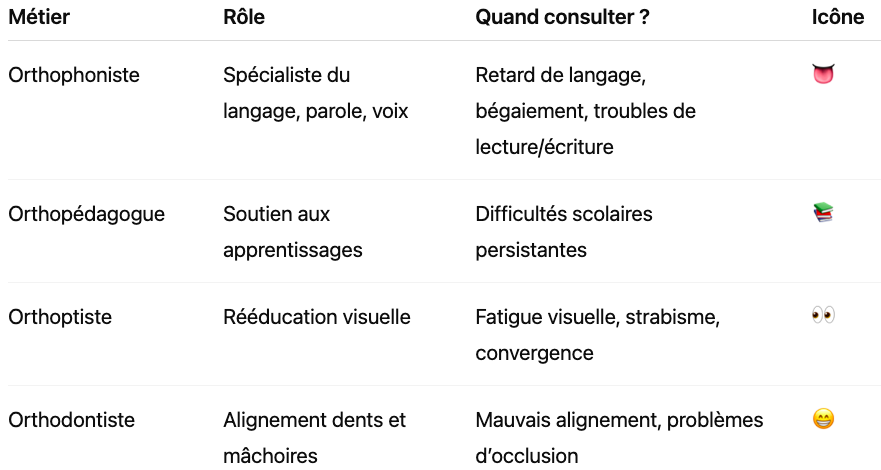
- 👅 The speech therapist (orthophonist): the word wizard. When speaking, reading or writing becomes complicated, they’re the one who helps pick the thread back up.
Role: screens for and treats disorders of language, speech, voice and communication. This is who you consult for tests that reveal DYS disorders such as dyslexia, dyscalculia or dysorthographia – in other words, SLLDs: Specific Language and Learning Disorders. Once the diagnosis is made, they’re also the one who can plan ongoing support for your child, typically a weekly session of around thirty minutes.
When to consult?: delayed language development, stammering, reading/writing difficulties, letter confusion, comprehension difficulties.
It isn’t always easy to get an appointment with a speech therapist within a reasonable time. This is why the Ora-visio platform gives you access to professionals who can quickly offer to carry out assessments for your child and start follow-up support if needed, or simply give you advice.
- 📚 The educational therapist (orthopedagogue): the school-success super coach. Less well known, but invaluable for unblocking learning.
Role: trained in learning-support strategies, especially when neurodevelopmental disorders affect learning, they support children and adults facing learning difficulties.
When to consult?: persistent difficulties at school, need for personalised educational support.
- 👀 The orthoptist: the gym teacher for the eyes. Their sessions sometimes look like visual sports exercises.
Role: a specialist in visual rehabilitation.
When to consult?: visual fatigue, strabismus, convergence disorders. An assessment with an orthoptist is worthwhile if dyslexia is suspected. Indeed, before running tests with a speech therapist, it’s important to rule out a convergence problem, and therefore visual fatigue, that is preventing your child from learning to read. So Jules might not need speech therapy at all, but rather orthoptic rehabilitation!
- 😁 The orthodontist: the architect of the smile. Their playground: braces, aligners and stubborn jaws.
Role: a dental surgeon specialised in correcting teeth and jaws.
When to consult?: misaligned teeth, bite problems. In the case of delayed language development or stammering, it’s important to also see an orthodontist. Indeed, it may not necessarily be an oral language disorder (also called dysphasia) but rather an OMD (orofacial myofunctional disorder), meaning a dysfunction of the lips, jaw, tongue and oropharynx.
“Who does what among the orthos?”
✅ In summary
Each “ortho” has a clearly distinct field. Knowing what they do saves time, avoids misunderstandings and helps you get the right support.
To find out more: