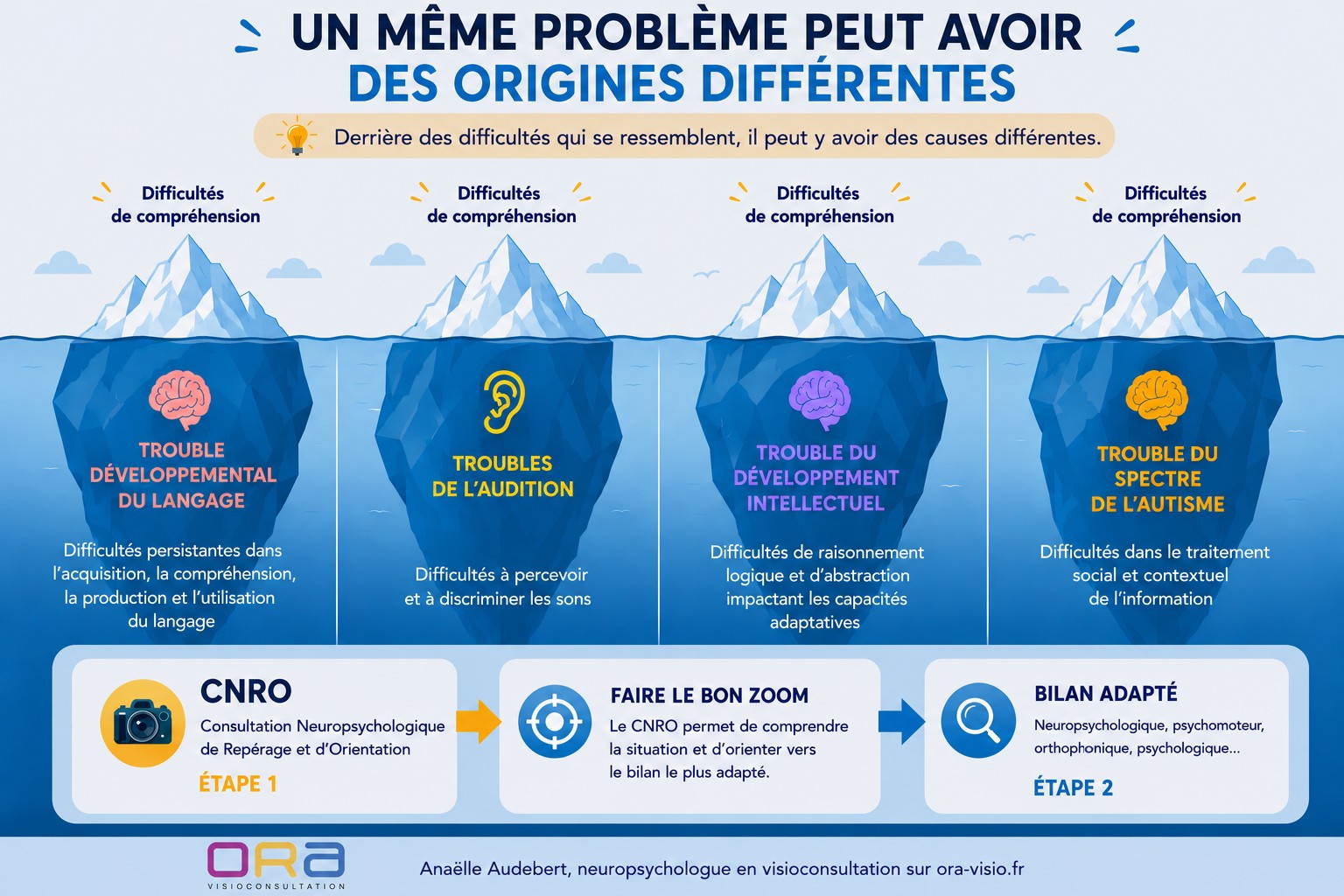
The neuropsychologist focuses their expertise on cognitive functions – in other words, how the brain manages learning and information. When faced with a significant delay and/or persistent difficulties at school, it can be worth having a neuropsychological assessment carried out. Through a series of precise tests, the professional can determine whether the observed symptoms are pathological in nature and whether they are linked to a cognitive disorder.
What symptoms suggest an assessment is needed?
In children, several reasons can justify a neuropsychological assessment. Among the most common situations are:
- A significant delay – whether in language development, fine motor skills, or the child’s ability to draw;
- Persistent difficulties at school – particularly in the area of DYS disorders, namely reading, writing and maths, as well as attention disorders;
- A lack of progress, despite therapy with a speech and language therapist or occupational/psychomotor therapist;
- Unexplained academic failure, even though the child is engaged and motivated.
How to organise a neuropsychological assessment?
Traditionally, when these symptoms are observed, it is recommended to consult your GP, the school doctor, or the professional in charge of the child’s therapy. These professionals can then refer you to a neuropsychologist.
Note that while some SESSAD (French specialised home-support services) can carry out this assessment free of charge, seeing a private practitioner is not reimbursed by French national health insurance. As for the waiting time, it is generally long, although it can vary significantly from one region or department to another.
In the meantime, it is possible to carry out a few steps that will help strengthen the reliability of the assessment: requesting a speech and language assessment, an evaluation of the child’s reading, spelling or maths level from the school psychologist, and so on.
What happens during the assessment with a neuropsychologist?
Lasting from 3 to 6 hours depending on needs, the neuropsychological assessment begins with a clinical interview to piece together the child’s history.
Next, the professional draws on a “toolkit” of tests, chosen according to the patient’s difficulties. These tasks can be verbal or non-verbal and use different materials. Each task follows a very precise protocol to establish the child’s performance, benchmarked against the average observed in children of the same age.
The neuropsychological assessment continues with an oral discussion covering explanations and practical everyday advice. Finally, it concludes with a written report and, where appropriate, the introduction of a therapy programme.
What does a neuropsychological assessment reveal?
A neuropsychological assessment helps answer 3 questions:
- Are the difficulties/symptoms pathological in nature?
- Is this condition linked to a global or specific cognitive disorder?
- Why is the child struggling with these particular tasks or areas?
By answering these questions, the proposed strategies will be genuinely effective and well suited to supporting the child’s progress with their difficulties.
Don’t hesitate to get in touch with a neuropsychologist on the Ora-Visio platform : available remotely and specialised in neurodevelopmental disorders, they can advise you on the steps to take to help your child.