A leading professional for neurological disorders, the speech and language therapist has a wide range of tools and techniques to help children in their daily lives. Based on Neuro-Functional Reorganisation, the Padovan Method works around the “Walk / Talk / Think” triad to encourage the central nervous system to recover and develop. An overview.
What is the Padovan Method?
Developed in the 1970s by Brazilian Beatriz Padovan, then a primary school teacher, the eponymous method is based both on the work of Rudolf Steiner and the observations of Piaget. The former was interested in the interdependence of walking, talking and thinking, while the latter focused on sensorimotor intelligence.
The Padovan Method can be compared to a tree, where the trunk represents the nervous system and the branches represent functions that are interdependent with one another, but also dependent on the trunk. In other words, when a problem arises, the whole nervous system is affected, regardless of which function is involved.
Who is it for?
By acting on neurofunctional reorganisation, the Padovan Method has an extremely broad range of applications. It can therefore be recommended for learning difficulties (dyslexia, dyscalculia, dysphasia, dyspraxia, dysorthographia), behavioural disorders, ADHD or autism.
But this method can also help with sensorimotor disorders (laterality issues), language disorders (stammering), psycho-emotional difficulties, or even neurological disorders linked to trauma.
What happens in a “Padovan” session?
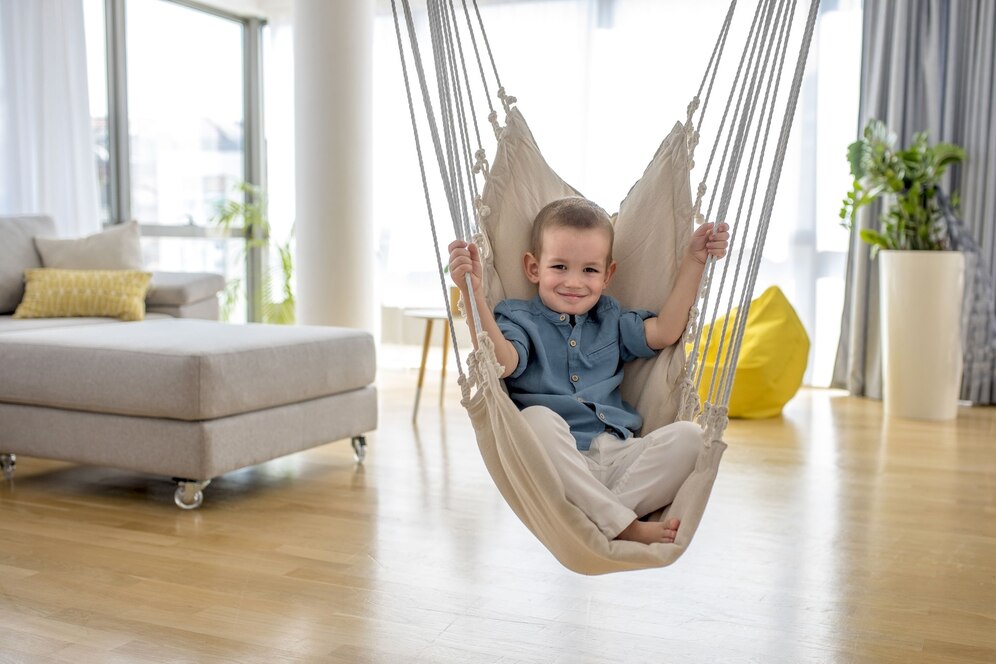
During the session, the speech and language therapist offers a series of movements, working through the milestones of “normal” motor development that occur between 0 and 3 years old, or even up to 7 in some cases. For example, rocking in a hammock (simulating being rocked in the womb), rolling, crawling, going on all fours, jumping, and so on.
Depending on the assessment results, the professional may also target exercises for the development of the eyes, hands and pre-linguistic functions (breathing, sucking, chewing, swallowing).
Note that each exercise is accompanied by a poem recited by the speech and language therapist to maintain the child’s rhythm, attention, hearing, imagination and movement synchronisation.
What makes the Padovan Method distinctive?
Led by a speech and language therapist, the Padovan Method applied to children with DYS, ADHD or ASD is built around a fundamental set of three principles:
- Regularity: sessions should be planned twice a week;
- Repetition: integrating the motor patterns being worked on requires repeating the movements;
- Rhythm: nursery rhymes help work on auditory attention and support the flow of movements.
If you’re interested in this approach, which takes into account the interactions between the body, the brain and language, don’t hesitate to get in touch with a speech and language therapist trained in the Padovan technique. On the Ora-Visio platform, you can already get in touch with a specialist in DYS, ADHD and ASD, the method’s priority focus.