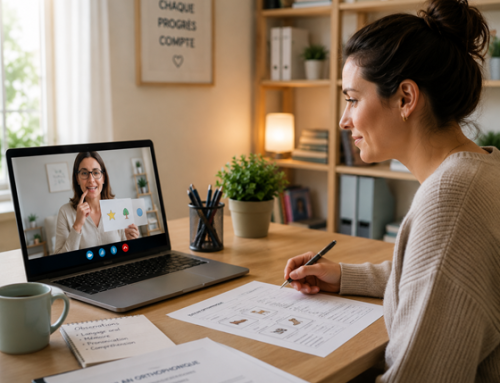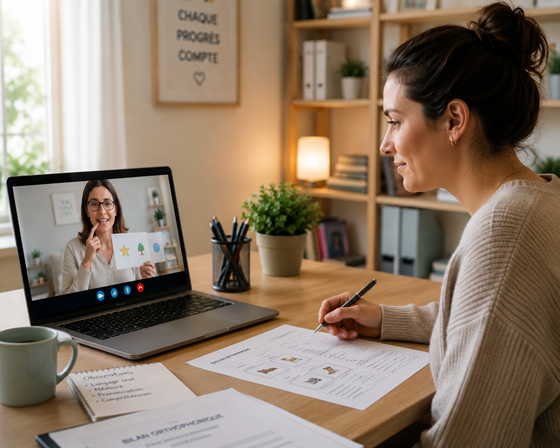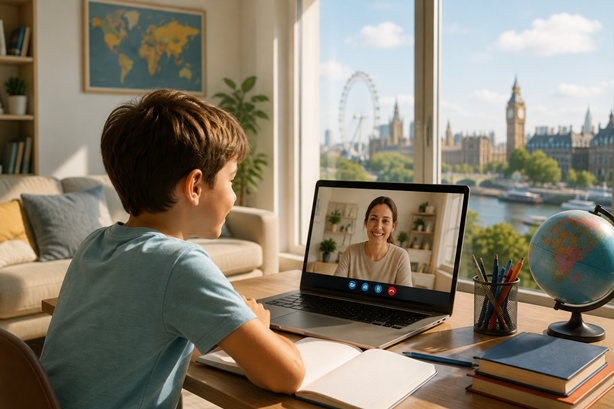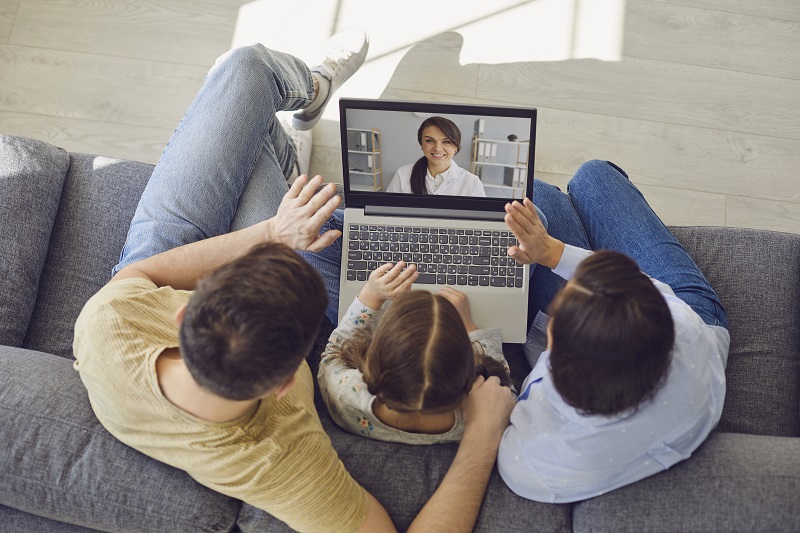
E-medicine was still in its infancy until last year. The new health conditions brought about by Covid-19 sped up its rollout. Today, teleconsultation has become widely established across the healthcare professions. This is the case for speech and language therapy, whose online sessions are starting to grow. Valérie, a speech and language therapist for over 20 years in the Maine-et-Loire region, shares her experience of teleconsultation with her patients, mostly primary-school children and teenagers.
Why did you choose to work via teleconsultation during lockdown?
For me, it was mainly my professional conscience that motivated me to practise teleconsultation during that period. I instantly thought this lockdown might last a long time, and for me, it was impossible to leave my patients without care for months. Our professional union quickly worked to make remote care possible. The ORA platform had already contacted me beforehand, which allowed me to complete the administrative steps so I could start working remotely as soon as remote care was authorised. Financially, I also needed to keep my income going.
What differences did you notice between patients consulting online and those coming to the practice?
For teenagers, I noticed it made the whole process lighter for them. Not having to travel meant they experienced it a bit better. As a result, they were more consistent, and I avoided the pitfall of frequent absences.
Another important point: they really enjoyed using the computer tool. For some children with attention disorders, particularly ADHD, using a computer helped capture their attention better. As for me, it allowed me to take more of a step back compared to in-person sessions. Not being immersed in the room gave me a different perspective. For example, by regularly using the online Memory game, I noticed how important the way a child looks at a piece of writing or an image really is. It became an opportunity to teach them to analyse and reproduce certain details differently.
What are the right conditions for running a speech therapy session by teleconsultation?
Beyond a good connection and decent computer equipment, which unfortunately isn’t the case for every patient (financial means, access to good network coverage…), I think it’s essential to have access to a platform like IGERIP for example, which offers rehabilitation tools. This software allows for better interaction with the patient through screen sharing. These tools still have room for improvement, but they do offer interactive activities for concentration, memory, and written language…
The presence of parents, just as in person, also seems essential to me. Parental guidance is a pillar of speech therapy treatment, and leading by example is, for me, the best approach, so I invite them to stay during the session.
As the therapist, using a graphics tablet also felt very practical and well suited to the task.
How did you run your teleconsultation sessions?
Besides the platforms mentioned above, we were able to download and share various materials online. Little by little, it became easier and easier for these children to handle the computer tool. It’s something they need to learn to master at school, but that they’re sometimes afraid to use. Teleconsultation helped them feel more at ease with it, and for some, it gave them the confidence to ask to use the computer tool in class too. With children with DYS disorders, I worked more with mental imagery (logical sequences…), which helped my patients build a mental representation and keep it in memory.
Were there cases where teleconsultation in speech therapy felt unsuitable?
In the case of one young patient, the mother had no computer equipment other than her phone, and it was very clear that the child’s difficulties combined with handling a smartphone made it impossible to run a proper tele-speech-therapy session.
During an online speech therapy session with a child who had an attention disorder, and who was clearly not very engaged by the computer tool, I got hung up on! A situation that would have been impossible in person, since I can be there with the child and manage those moments of stress.
Have you achieved results similar to in-person speech therapy follow-up?
If we focus on this health crisis period, when wearing a mask is mandatory in person, it seems clear to me that online speech therapy sessions are more effective and easier to run. Indeed, working on articulation and sounds with a mask on is absurd. Over a 30-minute session, the exchanges are continuous, so a mask creates unfavourable conditions.
It’s also a sharing of daily life and surroundings that you experience through teleconsultation, and this mutual discovery was enjoyable and instructive for me. Indeed, getting a sense of the living conditions of the child I’m working with is a real plus. We could talk about their interests, and they were able to show me their world.
Parents were very satisfied with these remote sessions. Some, however, wanted to occasionally schedule in-person sessions to maintain a connection, a personal contact, especially after the difficulties of lockdown. I also think that the occasional in-person session helps strengthen the bond between patients and the therapist.
How do you see the future of your profession?
In terms of logistics, teleconsultation is a huge step forward, and it seems very well suited to the work. My colleagues and I have really appreciated this way of working. A fellow speech therapist friend with a health condition of her own obviously found an added benefit in it too! That said, be careful not to equate online sessions with a higher number of appointments! Developing tele-speech-therapy doesn’t mean being able to run more sessions. From a strictly practical standpoint, the benefits, beyond those mentioned above, include the ability to fill gaps in medical deserts and to effectively follow up with French patients living abroad.
It’s also worth noting that working via video call is more tiring than working in a practice. I’m thinking in particular of all the setup involved and patients’ access to the computer tool (connection, logins, passwords, some account management difficulties…). Parents and patients need guidance, the process needs explaining, and ORA has been a great help with that. With patience and method, the platform’s team supported and guided me so everything ran smoothly. I believe teleconsultation is here to stay, because it offers real benefits for patients, and for some behavioural disorders, arguably even more than in-person sessions.