
In cycle 3, CM2 students spend 5h per week on mathematics lessons (8h on French). Building on the fundamental learning covered in cycle 2, they develop their capacity for abstraction, rigour and reasoning, which they can put to use in everyday life…
The CM2 curriculum
In mathematics, the CM2 class is organised around 3 key areas:
- Numbers and calculations: identifying, writing, comparing and ordering whole numbers, decimal numbers and fractions, doing mental addition and multiplication, mastering written calculation techniques, solving everyday problems…
- Space and geometry: mastering the vocabulary around flat shapes and common solids, being able to describe, reproduce (with appropriate instruments) and construct them, solving problems involving measuring and drawing, finding their way around and moving in a familiar space…
- Quantities and measurements: mastering, comparing and solving problems related to lengths, masses, volumes, areas, angles, time, durations or currency.
End-of-year expectations for CM2 in Mathematics
By the end of the last year of elementary school, CM2 students must, in mathematics, be able to use and represent large whole numbers, simple fractions and decimal numbers, perform mental or written calculations and solve problems using these concepts…
In terms of quantities and measurements, the CM2 student must compare, estimate, measure and solve problems with whole or decimal numbers related to geometric quantities (length, area, volume and angle), using the specific measuring instruments.
In space and geometry, they can describe and carry out movements on a plan or a map, program a robot’s movements, know positional vocabulary and create representations (models, plans, diagrams). They must also be able to recognise, name, describe, reproduce and represent solids and geometric shapes. They must use some geometric relationships such as perpendicularity and parallelism.
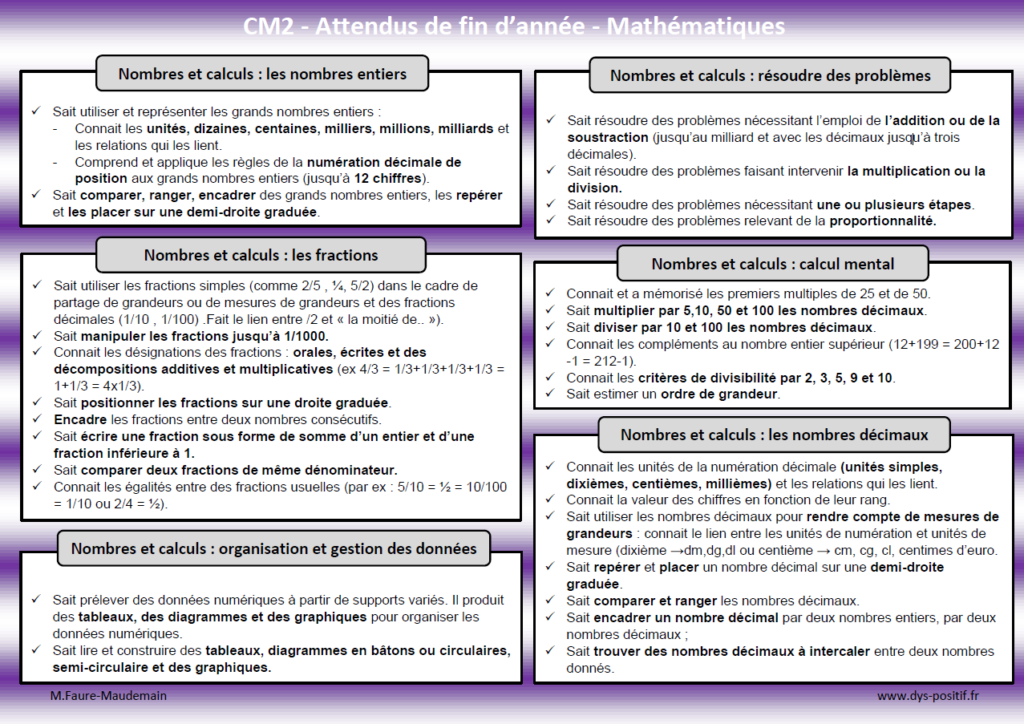
To find out more about the end-of-CM2 expectations in mathematics, click here!

