
As part of cycle 2, dedicated to fundamental learning (which also includes the CP and CE2 classes), a CE1 student has 5h of mathematics per week to develop their rigour, precision, and enjoyment of reasoning. As with French, this number of hours aims to prepare them for cycle 3, dedicated to deepening these foundations.
The CE1 curriculum
While problem-solving — particularly in writing — is at the heart of CE1 mathematics lessons, the subject is organised into 3 parts:
- Numbers and calculations: working with numbers below 1000, comparing them, ordering them and knowing the number sequence, memorising the addition and multiplication tables (2, 3, 4 and 5), learning the operating techniques for addition, subtraction and multiplication, practising mental arithmetic…
- Geometry: recognising, describing and reproducing flat or solid shapes using specific instruments, learning the associated vocabulary…
- Quantities and measurements: comparing units of length (cm, m, km), mass (g, kg), capacity (cl, l), time (minutes, hour) and currency (cents, euros).
End-of-year expectations for CE1 in Mathematics
By the end of the CE1 class in mathematics, a student must understand and use whole numbers up to 1000 to solve problems (which requires being able to calculate them mentally or in writing).
In terms of quantities and measurements, they must be able to compare, estimate and measure units, using the appropriate vocabulary and instruments. In geometry, they must recognise, name and describe common solids (cube, sphere, cone, pyramid, cuboid) and common geometric shapes (square, rectangle, triangle).
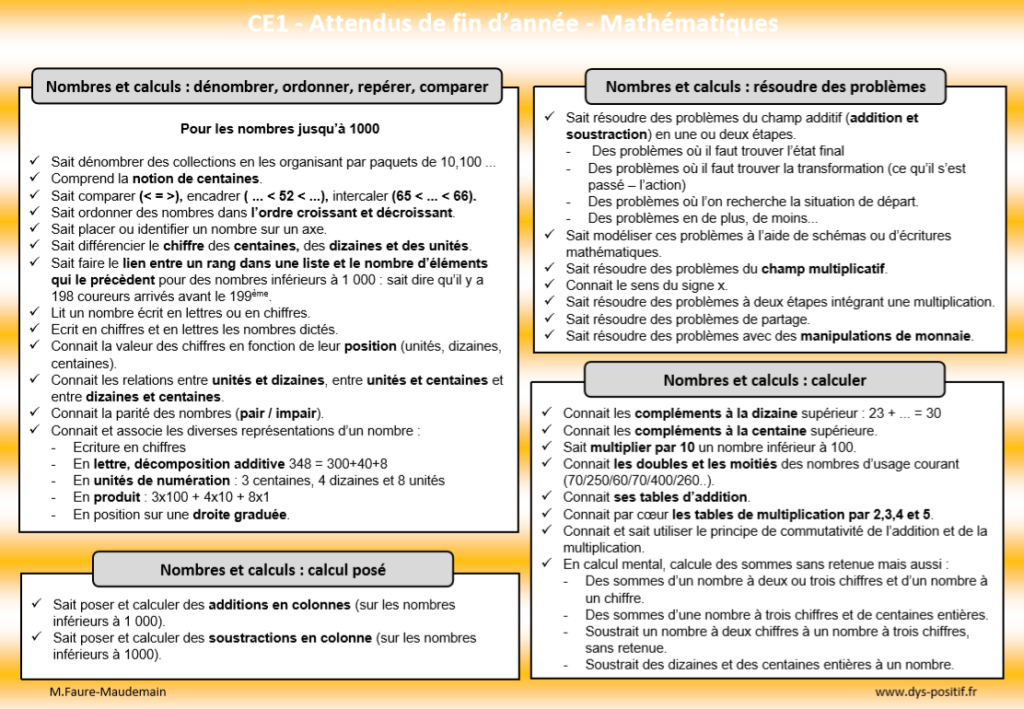
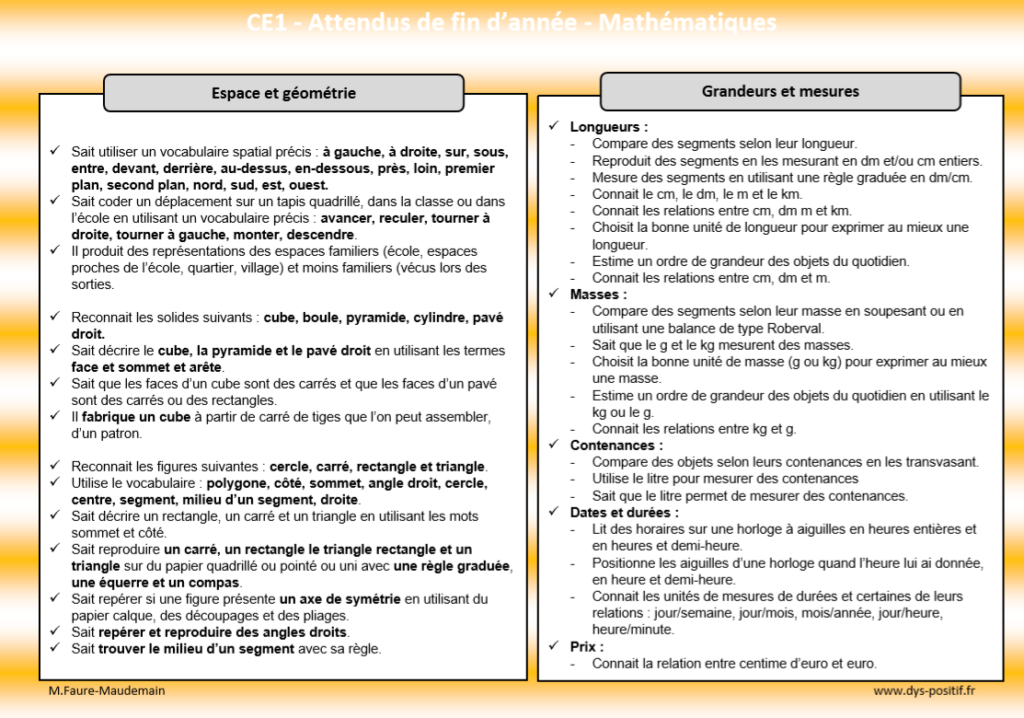
To find out more about the end-of-CE1 expectations in mathematics, click here!

