
According to the definition given by France’s health insurance body, “written language disorders (dyslexia, dysorthographia and dysgraphia) appear as confusion and reversal of sounds and letters, spelling mistakes, or even slow and illegible handwriting.” [1] But these difficulties, far from being an exhaustive list, can also combine with one another. Here are 3 concrete examples of what dyslexic people experience every day, and why it’s so important to refer them to a speech and language therapist from a young age…
Example 1: Letters that seem to play leapfrog
A Swedish developer, Victor Widell, worked with a dyslexic friend to create a page offering as representative a reading experience as possible of what she personally experienced. Striking in its honesty, this page reflects her own dyslexia — namely, letters that seem to play leapfrog. Here, even though the young woman can read, it takes her a great deal of concentration: see for yourself!
Example 2: Poorly segmented words
Other dyslexic people struggle to see words correctly — either they appear stuck together as if all the spaces had disappeared, or they are poorly segmented…
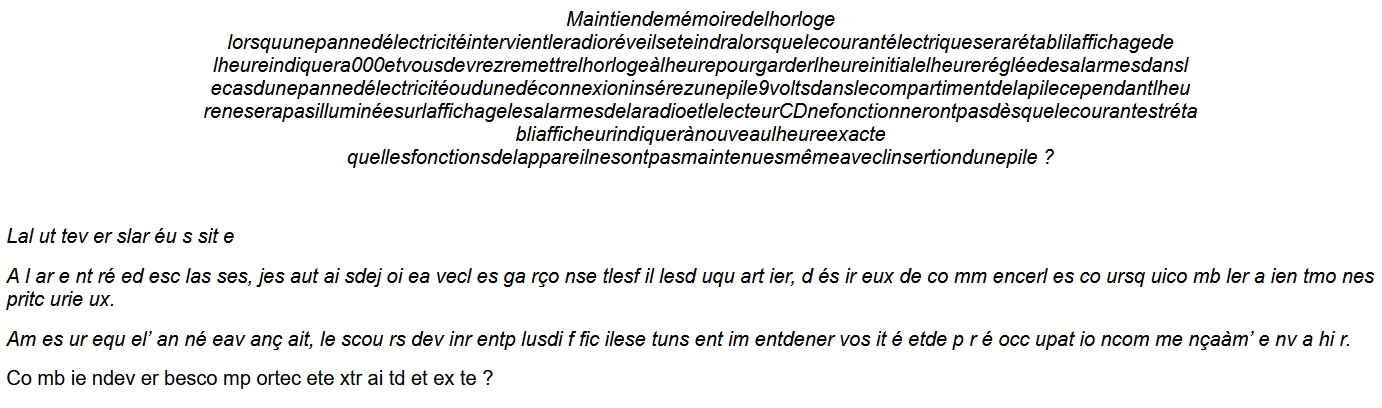
Even if they manage to read the text, they face more difficulty than others, since it takes one reading just to segment the words correctly, another to understand the sentence, and a final one to answer the question…
Example 3: Letters that are similar, partial, or in the wrong direction
Traditionally, dyslexic people struggle to see letters normally: some read them back to front, easily confusing “p” and “q” as well as “d” and “b.” Others struggle to tell apart letters that look similar, such as “o,” “e” and “c”.
But dyslexic people can also reverse an entire word, such as “was” becoming “saw,” or “top” becoming “pot.”
How can you help a dyslexic person with these difficulties?
The reading and writing difficulties faced by dyslexic people are mainly explained by auditory and visual issues: the former make it impossible to hear the different sounds within a word, while the latter make it impossible to focus both eyes on a letter and follow the line of the page.
Present throughout their entire life, these disorders can gradually affect confidence and self-esteem. Fortunately, with the help of a speech and language therapist and exercises suited to their specific needs, it is possible to reduce these difficulties and their knock-on effects in daily life and at school.
On the Ora-Visio platform, ask for help from an online professional: the sooner the disorder is identified, the sooner the dyslexic person can access solutions to help make up for this difference in how the brain works.
[1] Source: https://www.ameli.fr/assure/sante/themes/troubles-langage-ecrit/symptomes-detection-diagnostic
[/fusion_text][/fusion_builder_column][/fusion_builder_row][/fusion_builder_container]