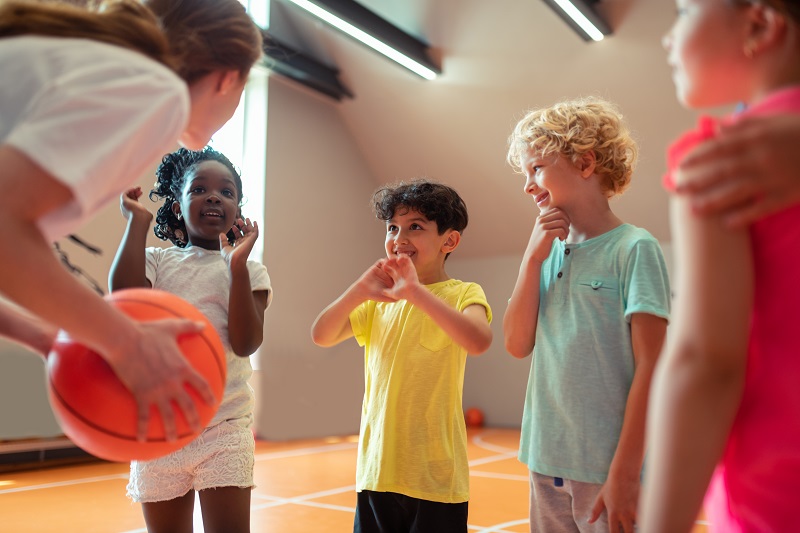
With their small everyday clumsiness and hesitant movements, the dyspraxic child isn’t very comfortable in the classroom. Sadly, break time and sports activities bring them no more satisfaction or self-confidence. Yet simple adjustments can make all the difference at school, just as they can on the field. To avoid revealing their difficulty, they will carefully avoid sports activities, unknowingly letting their motor skills deteriorate further. Yet anticipation, ease, and adaptations can transform the dyspraxic child’s life! How can this pupil be reconciled with PE lessons? Which adjustments actually work in sport?
A quick reminder on dyspraxia
This disorder is characterised by abnormalities in the planning and automation of voluntary movements. Put simply, the dyspraxic child is much clumsier than their classmates. Carrying out a voluntary action (tying shoelaces, doing a jigsaw, cutting with scissors…) is an ordeal that the child performs incredibly slowly, for a mediocre result. On top of that, they’re unable to reproduce an action they’ve just performed. The automation of movements is also disrupted. Occasionally, the child will manage the action successfully, but if they try to repeat it, they may fail again, because they don’t standardise their performance and they tire very quickly.
What are the consequences for playing sport?
There seems to be no fixed pattern for the dyspraxic pupil in PE! Looking more closely, some excel at a sport where others are simply unable to play it. The child who can’t manage to put on their t-shirt might turn out to be excellent at table tennis! While most dyspraxic children face major motor difficulties, when the desire to play a sport is strong and the teacher adapts their coaching to the pupil’s dyspraxia, pleasant surprises can sometimes happen. Let’s not forget, though, that the quality and intensity of training have no impact on the outcome – nor does the child’s goodwill and effort, if they’re practising a sport that isn’t right for them. Forcing them to keep up with the same training as their classmates would then mean pointless, harmful strain on their self-esteem. Only their brain’s capabilities and aptitudes can allow them to achieve success in the sport they’ve chosen. So while playing a sport can potentially be difficult and require a lot of effort, if the discipline suits them, the child will build their self-confidence, assert themselves and thrive further.
“Sports activities are, especially for young boys, a favourite leisure pursuit that lets them measure themselves against their peers and engage in the contests and competitions needed to build their sense of identity.”
Valérie Bogusz: Psychologist in Bordeaux
What is your dyspraxic child’s sporting profile?
Profiles vary greatly from one child to another. Experiences, surroundings, personality… many factors come into play, and dyspraxic children don’t all approach sport the same way. Two types of personality can be distinguished:
- Active: with a marked enthusiasm for motor activities. These are children who are always on the move, who enjoy playing different sports and motor games, without being held back by their dyspraxia. For this type of profile, it’s important to preserve the pleasure of moving, by letting PE teachers and coaches know about their disorder so they can adapt their lessons.
- Blocked: with an aversion to sport and motor games. These children feel ashamed to move and take part in sports activities. Fear of ridicule, of others’ judgment and of humiliation is overwhelming. For these pupils, communication and dialogue must be restored or established as quickly as possible. The family, sports teachers, the professionals in charge of the child’s therapy, and the child themselves must come together to define the adjustments and adaptations that can restore the pleasure of playing sport.
Adapting PE for dyspraxic pupils
For sport in general
Reproducing a movement: since the pupil isn’t able to do this by imitation, verbal explanation should be favoured. The solution: describe each step of the movement in words, breaking it down stage by stage. And why not use rhymes to help memorise the movement better?
Basic adaptations: certain movements that are too difficult to reproduce should be avoided or adapted. To help with spatial awareness, colour-coded equipment should always be used, following a consistent logic on the field and on the child: red marker on the right + take-off foot (right) also marked in red. Marking out play zones, starting points, finish lines… Working in a lane is also recommended.
The teacher’s assessment should be based on the child’s new skills, not on the standard requirements of the lesson.
In the changing room: since tying laces, doing up a zip, or simply tidying and organising their sports kit are real challenges for them, these young athletes should be allowed to arrive at school already dressed in their sports kit and only need to change their t-shirt. Parents should favour Velcro shoes, elasticated trousers, and add labels showing the front and back of clothes.
For combat sports
- Choose a more experienced opponent, so they can manage the DYS child’s explosive energy and potentially dangerous uncontrolled movements.
For team games
- Encourage the child to stop before shooting or passing.
- Avoid actions such as bounce passes or dribbling.
- Give them extra time before acting.
- Reduce the number of players and clearly mark out the playing area.
- Provide a free-play zone.
For athletics
- Running: colour-coded markers on the child and around the space are essential (left/right/start/finish)
Verbal cues too, such as a three-step start, for example.
For hurdles, remember to lower the height and mark the take-off zone on the ground.
- Throwing: since the object may be thrown with no control and hit someone, it’s recommended to mark out zones, focus mainly on the release phase, and avoid rotations and crossover steps.
- Jumping: focus on the take-off phase without worrying about the landing or the run-up.
For water sports
Balance and breath coordination are the main obstacles for dyspraxic children learning to swim. Adaptations should take these difficulties into account:
- Help the child feel comfortable in the water so they get used to this environment.
- Make them independent in the water without imposing a particular swimming technique.
- Separate learning arm movements from learning leg movements.
- Allow the child to use several swimming techniques at the same time.
- Give clear spatial cues and describe the movements in words instead of demonstrating them.
For racquet sports
Speed, anticipation, the unpredictable trajectory of the ball, and the space behind the player are all obstacles for the dyspraxic athlete. A few adaptations are needed:
- Offer a shorter handle, get used to the movement by playing with the hand first, try Velcro racquets and balls, use slower balls.
- Reduce the size of the playing area.
- Adapt the serve to their abilities.
For gymnastics
The main difficulties for the dyspraxic pupil practising gymnastics are balance and, with it, the risk of falling, but also a lack of coordination in sequences, two-footed take-offs and disorientation. For this activity, here are a few possible adaptations:
- Adjust conditions by making the environment safer, lowering heights and choosing suitable equipment (larger balls, foam mats…).
- Dictate sequences by breaking them down into steps.
For dance
Here again, emotions and energy are hard to control, and learning sequences is a challenge. Yet the dancer is rich in imagination when it comes to choreography. A few solutions for getting dyspraxic children dancing:
- Encourage improvisation and letting go emotionally.
- Work on the concepts of slowness and speed.
- Encourage group work.
- Offer the chance to handle props.
The coach’s understanding, the PE teacher’s adjustments, and the parents’ attentive listening open wide the doors of the stadium, the gym and the sports hall to dyspraxic children. The key lies in open dialogue about the disorder and the motor difficulties. Understood and encouraged, the young athlete will find the discipline that suits them, until the final score reads:
Self-confidence: 1 / Dyspraxia: 0