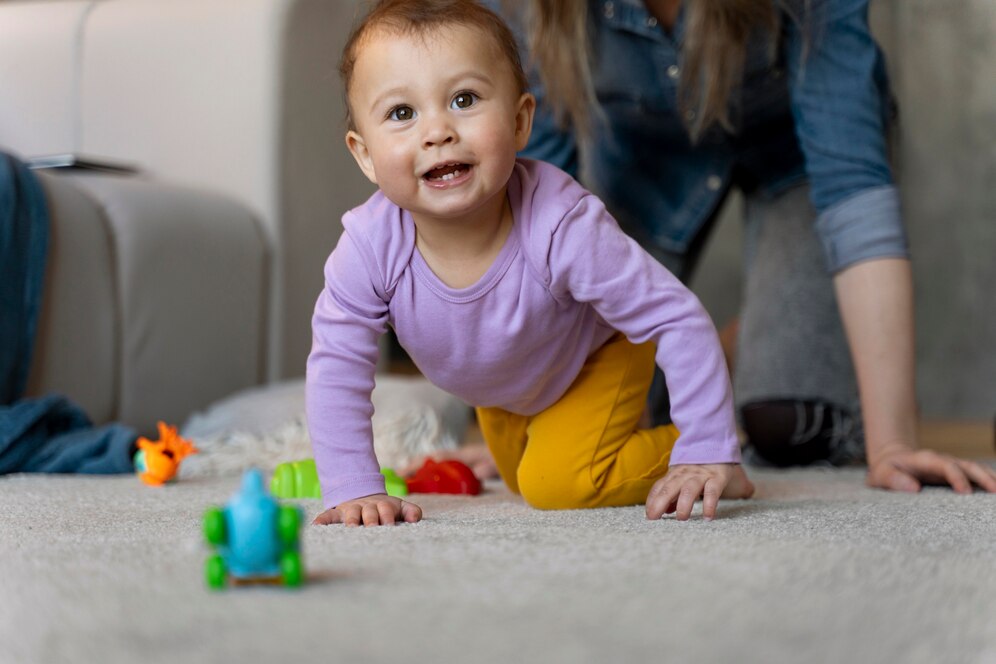
Generally speaking, an occupational therapist gets involved when a condition or illness limits a child’s ability to carry out everyday activities. These difficulties show up at school, at home, or during leisure activities. The earlier support begins, the better the chances of improving the child’s independence, or even reducing or eliminating certain complications. Even babies aged 0 to 3 can benefit from it…
Why is paediatric occupational therapy valuable for your child?
The French National Authority for Health (HAS) recommends early intervention for infants or young children as soon as difficulties are suspected or identified. The aim is to support the child’s development as effectively as possible, limiting increased risk and reducing complications.
Intervening while the child is still young makes it possible to make full use of their brain’s plasticity: the earlier a professional gets involved, the greater the long-term benefits for the child.
Occupational therapy aims to maintain, restore and enable human activities in a way that is independent, effective and safe. For babies aged 0 to 3, whose independence is still extremely limited, it takes a holistic approach, connecting the child, their activities and their environment.
How does paediatric occupational therapy work?
The professional supports the child’s independence and autonomy, helping to create a harmonious occupational balance within the family. For a baby aged 0 to 3, the range of activities involved includes social interaction (babbling, eye contact, smiling…), movement (rolling over, crawling, walking…), sleep, feeding (moving on to solid food, using cutlery…), as well as personal care (washing, drying off, brushing teeth…), dressing (putting clothes on the right way round, tying shoelaces…) and play (pouring, building, handling objects…).
If the paediatric occupational therapist notices difficulties in developing certain essential skills, they work across several areas: sensory and perceptual (food texture, noise…), gross and fine motor skills (falling, climbing, playing ball, coordinating both hands…), cognitive (imitating, counting, scribbling…), social interaction, equipment and adjustments to the environment…
When should you see an occupational therapist?
Any suspected difficulty can be a reason to consult an occupational therapist, whatever the child’s age. Difficulties are traditionally observed in one of these 3 areas:
- At home: putting clothes on the wrong way round, struggling to tie shoelaces, poor grip on cutlery, needing constant help in the bathroom, clumsiness with objects, needing constant prompting to take initiative, etc.
- Leisure activities: coordination problems in sport (swimming, cycling…), difficulty catching a ball, going outside the lines when colouring, etc.
- At school: slow, illegible handwriting, disorganisation, frequent distraction, lack of precision, difficulty following instructions, etc.
From the very first consultation, the occupational therapist can advise you on the steps to follow and whether it may be necessary to carry out a full assessment, in order to evaluate the causes of the difficulties and determine the compensatory techniques required.