While the abacus is one of the fastest ways to calculate and learn mathematics, learning to use it brings other important benefits, particularly for children with DYS disorders. While it can undeniably help dyscalculic pupils, the abacus is also useful for dyslexic children. Here’s why.
A tool that supports mathematical learning
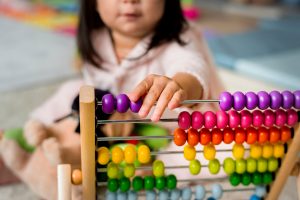
Made up of a rectangular frame with rods along which beads slide (often in different colours), the abacus can help a child rediscover the meaning of mathematics. In nursery school, this tool helps them grasp the concept of number, while in primary school it helps them develop calculation algorithms and study decimal numbers.
A child with dyscalculia has a deficit in working memory and visuospatial skills. To solve a problem, they need to remember the answer at each step: with the visualisation technique, which involves doing calculations in their mind (using a virtual abacus), they do this unconsciously and so strengthen their memorisation skills.
For dyslexic children, who struggle to remember words, numbers and formulas, it helps develop logic and comprehension skills. Thanks to this physical object, they can visualise problems in order to solve them.
Other benefits of the abacus for children with DYS
Using the abacus involves moving the beads with the hands and fingers: this manipulation stimulates the brain and sensory organs, helping to improve the child’s overall motor skills.
By learning to do calculations in their mind, the child remembers each step and so works on increasing their concentration. Faced with a maths problem, they focus on the final step of the calculation to find the answer.
Finally, the abacus can also reduce the child’s stress: by stimulating the brain, it helps calm anxiety.
The abacus, an accessible tool for tutoring support
While using an abacus is not standard practice in French schools, it is entirely possible to use it as part of tutoring support, to help your child with DYS “give shape” to numbers. Better still, using it can help consolidate the basics and make their maths learning more solid.
For children aged 3 to 6, it is recommended to use a “classic” abacus, with its 10 rows of 10 beads in different colours. After age 6, it is possible to choose a more compact, two-part Japanese soroban, with 5 beads per row.
Note that the earlier a child starts, the more easily they grasp the concepts of arithmetic, strengthening their sense of achievement and self-confidence…
In any case, don’t hesitate to bring up the subject of the abacus with professionals, particularly in tutoring support. Specialising in DYS disorders, the Ora-Visio platform offers correspondence courses, group classes, and also online support classes to progressively help your children overcome their difficulties.