While it’s a real asset for the child, bilingualism is also a source of worry for most parents. From mispronounced sounds to shaky sentence structure, there are plenty of things to be concerned about. Does bilingualism pose a risk to normal language development? How can you tell natural difficulties apart from genuine disorders? How can you help a bilingual child who has a language disorder?
Language development in bilingual children
Defining bilingualism
The term is very broad, as there are actually several distinct categories.
- Early bilingualism refers to a child immersed in two different languages from birth. When exposure to both languages is equal, this is known as simultaneous early bilingualism. When the family is monolingual but the child has regular contact with a close foreign-language speaker (a childminder, a foreign-language school), this is known as sequential early bilingualism.
- Late bilingualism refers to a child who acquires another language after the age of 6-7.
The particularities of bilingualism in language learning
Before age 2, there’s no difference in language development between a bilingual child and a monolingual child. It’s only from their second year onwards that a child becomes aware of the distinct features of each language they’re exposed to.
The size of their vocabulary is similar to that of a monolingual child, as long as the right way of counting is used! Words acquired in both languages must be taken into account. For example, if a child knows “chat” and “cat”, both should count as two separate vocabulary words. And if the child mixes up their two languages? That’s perfectly normal.
“It’s also completely natural for a bilingual child to mix sounds, words, and sentence structures between the two languages at different periods. This is part of their language development.”
Anne-Laure HITTINGER, speech and language therapist
A bilingual child won’t necessarily build up the same categories of words at the same pace in both languages. For example, they might use common nouns more in one language while mastering verbs much better in the other.
There’s also no need to worry about the “seesaw effect”: a period during which a child progresses faster in one language than the other. It’s entirely normal for a child to develop each language at a different pace. With daily language immersion, this gap naturally disappears between ages 4 and 5.
Another distinctive trait of bilingual children is “code-switching,” or mixing languages together. Here again, this is a normal tendency that sometimes affects bilingual adults too.
Language disorders and bilingualism
Recognising early warning signs
A language disorder won’t be addressed the same way in a monolingual child, a simultaneous bilingual child, an early sequential bilingual child, and a late bilingual child.
The monolingual French-speaking norm therefore doesn’t apply when assessing bilingual children’s speech and language. The therapist’s rehabilitation strategy must be adapted accordingly. A language disorder can show up in several ways between 18 months and 2 years old:
- if the child doesn’t react when spoken to,
- if they don’t respond to their own name,
- if they don’t speak at all,
- if what they say is incomprehensible.
These observations should be followed up with a speech and language assessment.
From age 3 onwards, issues tend to involve comprehension, expression, sentence structure, pronunciation, or a limited vocabulary. Below is a detailed list of warning signs from a document published by the FNO (Fédération Nationale des Orthophonistes, the French national federation of speech and language therapists).
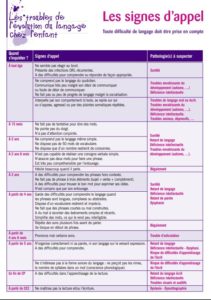
Source of the file: https://solidarites-sante.gouv.fr/IMG/pdf/03.fiche_signes_appel-2.pdf
Helping your bilingual child with a language disorder
Daily practice
Whether or not there’s a language disorder, regular practice of both languages is essential for balanced development. For expatriate families, it’s important to speak to the child in their mother tongue from birth, to build a positive association with their native language. This can take the form of songs, books, or games, so that the language is linked to an enjoyable context.
When a language disorder is identified in a bilingual child, there’s no reason to stop speaking to them in their mother tongue, as bilingualism is in no way the cause of their disorder.
The right approach to take: give structure to their bilingualism
- linking a language to a person: this is the OPOL strategy (One Parent One Language), a method in which each parent speaks their own mother tongue.
- linking a language to a place: French might be spoken at school and English at home, for example.
- linking a language to an activity: games might happen in French and meals in English, for example.
The role of the speech and language therapist
Speech and language therapy sessions help the child overcome their difficulties, all the more so when combined with adapted learning approaches. It’s worth remembering that these disorders aren’t linked to bilingualism itself, and appear in both languages without distinction.
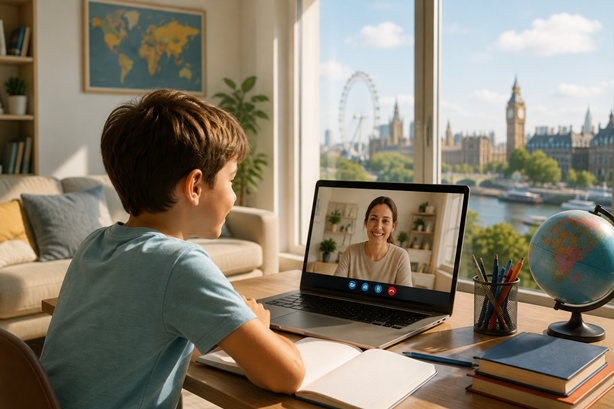
Choosing the right speech and language therapist matters. The therapy the child follows will also need to take into account which category of bilingualism the young patient falls into. Finding a therapist specialised in the different categories of bilingualism, as well as in speech and language disorders, isn’t always easy depending on where you live. On top of medical deserts in certain French towns and regions, the situation for expatriate families is even more complicated. It was to help these children that the ORA online consultation platform was created. With its speech and language teleconsultation services accessible from anywhere in the world, ORA meets strong demand for assessments and therapy sessions from families lacking access to healthcare professionals or living abroad. This network of qualified practitioners makes it possible to choose from online speech and language therapists specialised in bilingualism, multilingualism, and related language disorders.