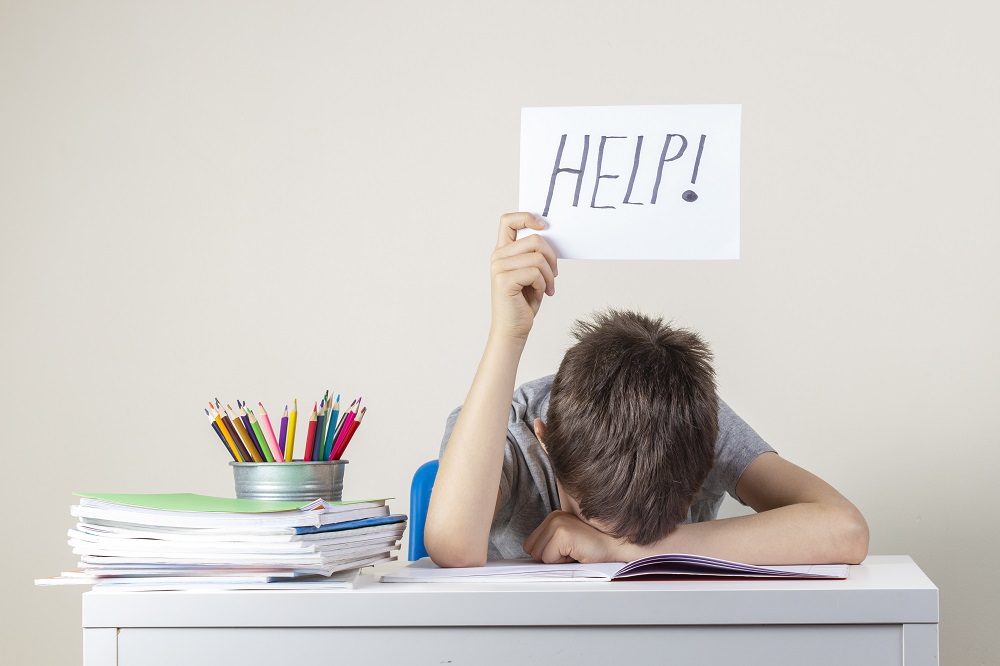
« A few minutes before your work meeting, your presentation file has disappeared. The printer is broken, and there’s no way to print a new copy. Exhausted after a sleepless night preparing for this meeting, you feel overwhelmed. The situation seems unmanageable, and no solution comes to mind. This stresses you out even more. You can no longer think clearly or step back, and the vicious circle intensifies. » You’ve just experienced a day in the life of a child with a dysexecutive disorder. What is dysexecutive syndrome? How can you recognise the symptoms? What can you do to help your child? Here’s a closer look at this neurodevelopmental disorder.
Defining dysexecutive syndrome
The executive system is responsible for planning, supervising and managing thought and behaviour. The associated syndrome is, in fact, a failure of this system. Affected children show a lack of initiative, poor inhibition, strategic difficulties, and problems with working memory. Dysexecutive syndrome can be associated with attention disorders and low self-confidence.
Executive functions: what exactly are they?
Executive functions bring together several different abilities: organisational strategies (the ability to choose the most relevant action, to anticipate, and to plan), inhibition abilities (knowing how to filter and control certain reactions in order to adapt one’s physical or mental behaviour), and mental flexibility (being able to focus attention on several things at once and switch between them while staying in control of the situation). While dysexecutive syndrome is sometimes associated with ADHD, its scope is actually far broader than attention disorders alone.
It’s important to keep in mind that toddlers’ immaturity naturally comes with impulsivity and behaviours resembling dysexecutive disorder. However, this is considered normal in children aged 0 to 6. Beyond that age, certain warning signs should be watched for.
The different causes of dysexecutive syndrome
There are many medical and pathological causes that can lead to dysexecutive disorders or syndrome. The disorder can appear after a head injury, an infectious or inflammatory brain disease (severe meningitis, autoimmune, viral or bacterial encephalitis, etc.), a metabolic disease (such as Wilson’s disease), a brain tumour, a stroke, multiple sclerosis, the onset of neurological and genetic conditions such as epilepsy, or psychopathological disorders.
When no medical cause can be identified, the origin of the dysexecutive syndrome is described as “constitutional.”
How can dysexecutive syndrome be detected?
Warning signs at school
Whatever a child’s intellectual abilities, when they have a dysexecutive disorder, those abilities are considerably weakened. Struggling to structure tasks, having difficulty taking in several instructions at once, and being unable to stay focused on a goal, all these dysfunctions exhaust the pupil, since they demand enormous effort. Unfortunately, this extra mental workload is invisible, and people wrongly assume the pupil simply isn’t trying. It’s a double punishment for a child who works hard to do well without managing to. Lack of initiative, attention deficit, stubbornness that’s misread as defiance, isolation caused by poor impulse control… these are all signs worth taking seriously.
What kind of care helps treat your child?
To make first contact, the school’s psycho-medico-social centre (or equivalent school health/counselling service) should be informed. It will then be up to a paediatric neurologist or neuropsychiatrist to carry out a rigorous assessment before making a diagnosis. The standardised tests used will be suited to the child’s age and are generally strategy-based tests. Following this initial assessment, and depending on the specific way the child’s dysexecutive syndrome shows up, the doctor/paediatrician will decide what other examinations are needed. Parents can also request specific accommodations, in particular by putting together an MDPH file (the French disability agency application).
Helping my child with dysexecutive syndrome
Treating the dysexecutive disorder.
This involves therapeutic care from a psychologist, a speech therapist and/or an occupational therapist. Behavioural therapy and cognitive remediation sessions help the child learn to structure tasks, plan, stay focused, and adjust their behaviour. This rehabilitation works on two fronts: learning to build a routine, but also learning to step outside that routine without becoming lost!
For children with a mild to moderate disorder, rehabilitation focuses on problem-solving, self-control, identifying a goal, and planning the steps needed to reach it. The sessions also help the child grasp concepts through repetition, making it easier to retain this information by making it familiar.
When the executive dysfunction is more severe, the child’s environment will need to be adapted to help them thrive and work around their difficulties. Creating visual reminders, using a diary or planner, and calling on outside support are all good ways to help a child with dysexecutive disorders.
Consistency is the key to success!
As with all DYS treatments, consistency is essential to achieving good results. To give parents and their children every chance of success, the ORA teleconsultation platform provides access to speech therapists and child psychologists qualified in dysexecutive disorders. These healthcare professionals offer online appointments to make up for medical deserts in certain areas, and to make these services available to families who live far from a practice. A practical solution that ensures ongoing follow-up without having to travel to a clinic, online consultations are open to any parent short on time or without practitioners nearby.
Making everyday life easier for your child
Day to day, parents can also create new, reassuring routines, get involved in their children’s activities, and encourage their efforts. Here are a few examples of attitudes to adopt with a child who has dysexecutive syndrome:
- Tackling poor organisation:
Set up a daily schedule.
Offer activities that are very structured, broken down into clearly defined steps.
Display the detailed plan of the activity on the surface the child uses (table, desk).
Praise every sign of organisation and every small success, without waiting for a good final result.
- Tackling a lack of initiative:
Limit the number of options offered if the child runs out of ideas for an activity.
Regularly ask for the child’s opinion, without pressuring them to answer.
- Managing impulsivity:
Introduce a short pause when the child loses control of the situation. Suggest they do a simple action instead.
Set up a self-assessment chart for their impulsivity so they can monitor themselves.
- Supporting their working memory:
Offer single tasks and avoid giving several instructions at once.
Pair each individual instruction with a clear, precise goal.
Alternate between guided activity and rest.
Self-esteem and professional success with dysexecutive syndrome
Working on self-confidence
Struggling academically, with results far below the effort put in, self-esteem takes a serious hit. Add to that the mistaken judgement of parents or teachers convinced that the child simply isn’t trying hard enough, and there’s little chance the pupil will keep their self-confidence. Valuing the child, highlighting their achievements, and encouraging them are a good starting point for rebuilding the self-confidence of a child with dysexecutive disorder. Clearly explaining to them that this disabling situation isn’t their fault, and that they can improve a little more every day, is also helpful.
The professional future of a person with dysexecutive disorders
With regular, carefully followed rehabilitation, executive dysfunctions will lessen over time. In adulthood, career choices will naturally need to take into account whatever level of difficulty remains. This helps make social and professional integration easier for a person with the syndrome. Sessions with a specialised psychologist are generally needed to help them come to terms with this difference and manage it in their work environment, outside the reassuring context of home or school.
The journey of a family and child with a dysexecutive disorder is full of obstacles. Psychological support is sometimes also needed for parents who feel at a loss. Positive parenting, reward systems, and revisiting their own expectations are useful approaches for parents going through this. Still, it’s important to remember that a well-supported child can go on to thrive happily, build confidence, and pursue their dreams with ambition.