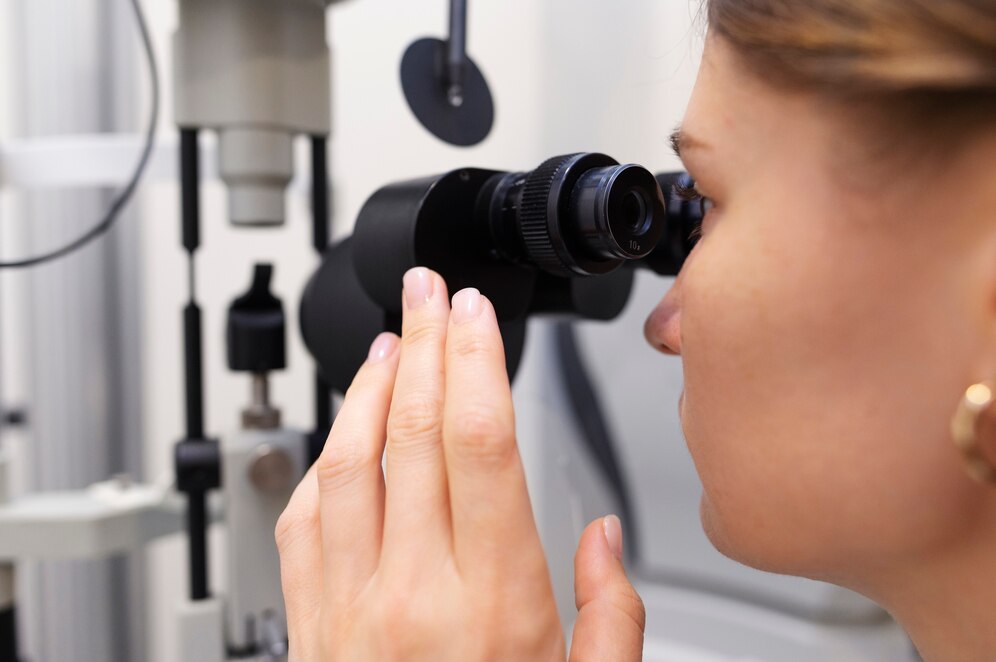
Dyspraxia is a neurodevelopmental disorder that interferes with the planning and automation of certain movements. In its visuo-spatial form, difficulties centre on spatial organisation and structuring, leading, at school, to slow and tiring reading, poor management of the page, or difficulty setting out maths problems. Strongly linked to neurovisual disorders, screening for visuo-spatial dyspraxia (VSD) requires an orthoptic assessment. Here’s how it works.
How do neurovisual disorders affect learning?
In France, vision is commonly considered the foundation of learning: as a result, a vision problem, known as a “neurovisual disorder,” can get in the way of reading, writing, and motor skill acquisition.
These neurovisual disorders include oculomotor disorders, which affect the movement of the eyeballs. This generally involves problems with fixation, visual pursuit, or a deficit in gaze strategy. In other words, the child struggles to select and pick out a specific piece of visual information.
The link between visuo-spatial dyspraxia and the eyes
Children with Visuo-Spatial Dyspraxia (VSD) experience difficulties with praxis (movement), the eyes, and spatial organisation. At school, symptoms include disfluent reading, skipping lines or words, slow handwriting that doesn’t follow the line, confusion between visually similar letters or more complex sounds, and so on.
When a teaching team suspects a child of having visuo-spatial dyspraxia, diagnosis by the speech-language therapist inevitably requires an orthoptic assessment (carried out alongside a neuropsychological assessment).
Indeed, this examination helps rule out a sensory or motor deficit, determine the quality of the child’s oculomotor tools and visual strategies, and assess whether or not any gaze disorders are present.
What does an orthoptic assessment involve?
Always carried out alongside a thorough ophthalmological examination, the orthoptic assessment begins with a detailed interview to trace the child’s history: medical background, family history, past or ongoing rehabilitation, ophthalmological follow-up, and so on.
Next comes a “general” examination to assess the child’s sensory state and, above all, rule out strabismus and oculomotor imbalance. The orthoptist then continues the assessment with an examination of eye movement: gaze fixation stability and endurance, pursuit movements in every direction, and reflexive and voluntary saccades.
The professional may also study visual strategies (for example, searching for a detail within a scene, arranged in a line or scattered), coordination between peripheral and central vision, visuo-spatial perception and organisation, and screen for gnosic function (recognising objects in picture books or photos).
Always considered alongside the assessments of other health professionals, the orthoptic assessment can help shape a dyspraxic child’s care plan. For example, by indicating whether their difficulties are more perceptual or constructive in nature, it helps tailor the overall rehabilitation, and may even highlight the relevance of orthoptic rehabilitation.