Every year in March since 1999, Brain Awareness Week has been raising public awareness of the importance of brain research.
But in everyday life, what are we really doing to improve our own concentration and that of our children?
Today, neuroscience shows that the brain needs movement to work well.
This is the idea behind Brain Gym, a simple method based on physical exercises to boost attention and wellbeing.
Thanks to discoveries in neuroscience, we now know that the brain likes to be stimulated: learning, thinking, discovering… but also moving. The link between body and brain is in fact a close one. Physical activity, even light activity, can help improve concentration, attention and overall wellbeing.
What is Brain Gym?
When movement helps the brain
Many parents notice that their child sometimes struggles to concentrate, stay calm, or get back to work after school. In those moments, moving around a little can sometimes help more than sitting still.
That’s exactly the idea behind Brain Gym, an approach that offers small movement exercises to promote attention, concentration, coordination and calm in children.
Created by the American educator Paul Dennison in the 1970s, this method is based on a simple principle: the body and the brain work together. By moving, we stimulate mental activity and can sometimes make learning easier.
These Brain Gym exercises are often used as short active breaks, for example before homework, when concentration dips, or to restore a sense of calm.
Why does Brain Gym improve concentration?
The Brain Gym method is based on the idea that movement stimulates brain connections and makes cognitive processes such as reading, writing or memorisation easier.
Certain specific movements are thought to activate communication between different areas of the brain, particularly between the left and right hemispheres.
The programme includes 26 simple body exercises, inspired by natural movements such as:
- walking or crossing the arms and legs
- stretching certain parts of the body
- performing eye movements
- practising breathing exercises
These activities are generally carried out at the start of a learning session or during moments of tiredness in order to restart attention. These movements are also used as short active breaks, for example before homework, when concentration dips, or to restore a sense of calm.
3 easy Brain Gym exercises to do at home
1. The Cross Crawl
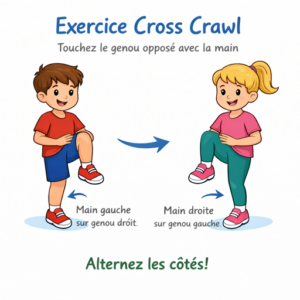
This exercise involves touching the left knee with the right hand, then the right knee with the left hand, alternating between the two. It aims to stimulate coordination and communication between the two hemispheres of the brain.
2. “Hook-ups”
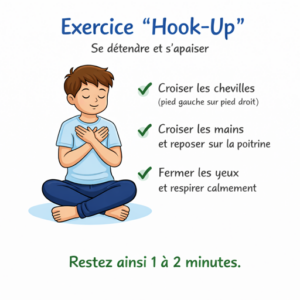
This is a relaxation exercise in which you cross your arms and legs while breathing deeply.
It is used to reduce stress and promote calm before a mental activity.
3. The “Lazy Eight”
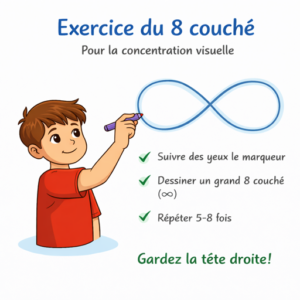
This exercise involves tracing a sideways figure eight (∞) in the air or on a sheet of paper, with the eyes or with the hand.
It promotes hand-eye coordination and concentration. It helps bring you back to the here and now.
How to bring Brain Gym into everyday life
Applications in education:
In a school setting, Brain Gym is often used to:
- improve concentration in class
- make learning to read and write easier
- help children manage stress or restlessness
- create active breaks during school activities
In an educational context where the importance of the body in cognitive processes is increasingly recognised, some teachers use it in the form of short 2-to-5-minute rituals.
Applications at home:
- before homework (2 min)
- after school
- screen break
- before an important activity
Is Brain Gym just for children?
The answer is no: Brain Gym exercises are not just for children, they can also help adults improve their concentration at work. Even though it is best known in schools, the exercises can be practised at any age: children, teenagers, adults and even older people.
The method created by Paul Dennison is based on a simple principle: movement can help restart attention, coordination and mental wellbeing. And these needs exist at every stage of life. This is also the principle behind the well-known POMODORO method used by people working at a computer, and a firm favourite among students revising for exams.
The benefits of Brain Gym
- improves concentration
- reduces stress
- supports learning
- creates positive routines
Conclusion
Brain Gym is a simple, accessible and effective method for improving children’s concentration… and parents’ too. A few minutes of movement are sometimes all it takes to restart attention and turn a difficult moment into a smoother one. Why not give it a try today?
Further resources:
1- a website: https://www.braingym.fr/le-brain-gym/
2- the reference book: Brain Gym: Teacher’s Edition
3- an article by our partner Dys-Positif : The Brain Gym method restores access to cognitive functions